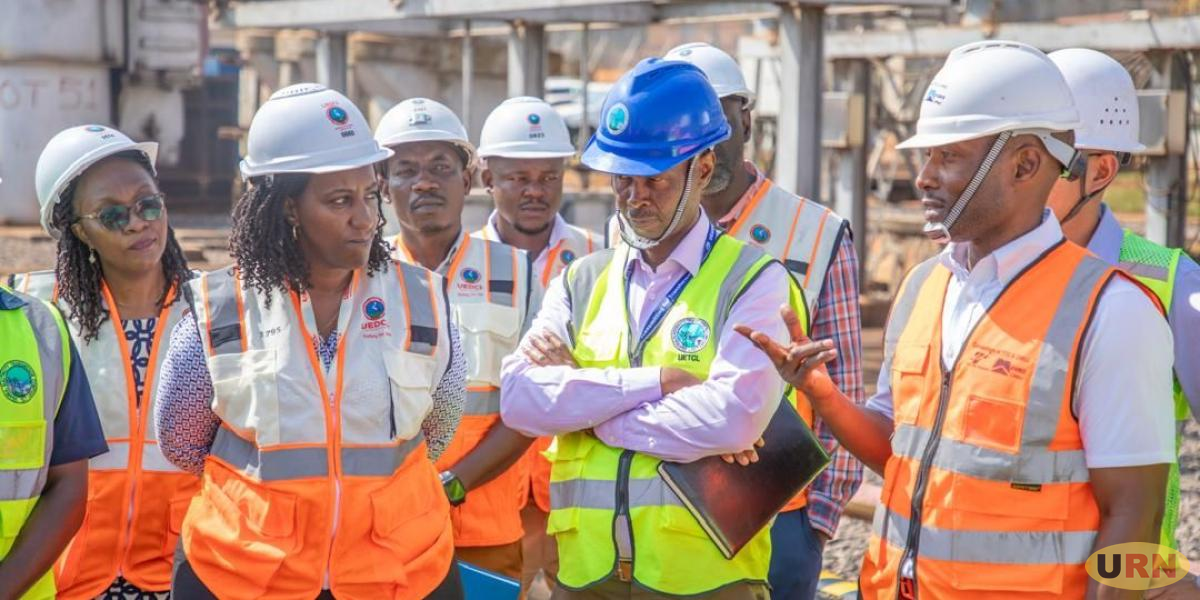
Government’s ambitious project to modernise the electricity transmission network serving the Greater Kampala Metropolitan Area (GKMA) has reached 90.57 per cent completion.
Once complete, the ongoing power interruptions will ultimately deliver a more reliable, future-ready electricity system capable of supporting rapid urbanisation and industrial growth.
The update emerged on Thursday following a joint inspection of the Greater Kampala Metropolitan Transmission System Improvement Project by the Uganda Electricity Transmission Company Limited (UETCL) and the Uganda Electricity Distribution Company Limited (UEDCL).

The inspection was led by UETCL Chief Executive Officer Eng. Richard Matsiko and UEDCL Acting Managing Director Eng. Joselynne Rwabwogo, who described the project as one of Uganda’s most strategic electricity infrastructure investments in recent years.
According to UETCL, Kampala’s metropolitan region remains the country’s largest consumer of electricity, with demand increasing by an estimated 15 per cent annually, driven by rapid population growth, urban expansion, industrialisation and commercial development.
The Greater Kampala Metropolitan Transmission System Improvement Project seeks to address these constraints by strengthening the high-voltage transmission backbone supplying Kampala and surrounding districts.
The project is financed through a JPY13 billion (approximately US$83.3 million) concessional loan from the Japan International Cooperation Agency (JICA) to the Government of Uganda and is being implemented by UETCL. Construction is being undertaken by a consortium comprising China Machinery Engineering Corporation (CMEC) and Toyota Tsusho Corporation (TTC).
The project comprises several critical infrastructure upgrades, including construction of new substations at Maya (Buloba) and Mukono; upgrading existing substations at Kawaala, Mutundwe and Bujagali; installation of new transmission lines and reconductoring existing 132kV transmission lines; and deployment of a mobile substation at Namungoona to strengthen supply reliability across the metropolitan area.
Officials confirmed that the Maya (Buloba) 220/132/33kV substation has already been completed, while work on the remaining components is progressing steadily.
The ongoing works have required scheduled electricity interruptions to enable engineers to safely reconnect transmission lines and upgrade existing substations.
Acknowledging public frustration, Eng. Matsiko apologised for the inconvenience but said the temporary disruptions are necessary to deliver lasting improvements.
“We understand the inconvenience these planned outages have caused businesses and residents across the Kampala Metropolitan Area. However, these interruptions are a necessary part of delivering a stronger, more reliable transmission network capable of meeting the city’s rapidly growing electricity demand.”
His counterpart, Eng. Rwabwogo, said the long-term benefits would far outweigh the short-term inconvenience.
“While customers are experiencing temporary interruptions today, the long-term benefits will be significant. This investment will improve the stability and quality of power supply, reduce network constraints, and enable us to serve customers more efficiently as demand continues to grow.”
Beyond improving electricity reliability, the upgraded transmission system is expected to support major strategic investments planned around the Greater Kampala Metropolitan Area.
According to UETCL, the strengthened network will significantly increase transmission capacity, reduce the risk of widespread power failures and improve grid resilience, while supporting industrial expansion and strategic national infrastructure, including the planned Buloba Pump Station under Uganda’s oil and gas development programme.
The improved network is also expected to accelerate UEDCL’s ambitious electricity access programme, which aims to connect up to 300,000 new electricity customers every year, expanding access to households, businesses and productive enterprises.
The Electricity Act, 1999, as amended by the Electricity (Amendment) Act, 2022, assigns UETCL responsibility for electricity transmission while UEDCL serves as the national electricity distributor.
The investment also advances objectives under the National Development Plan IV (NDP IV), which identifies reliable electricity infrastructure as a critical enabler of industrialisation, manufacturing, digital transformation and private sector growth. It further supports Uganda Vision 2040, which prioritises affordable, reliable and modern energy systems.
Internationally, the project contributes to Sustainable Development Goal (SDG) 7, which seeks to ensure access to affordable, reliable, sustainable and modern energy for all, while also supporting SDG 9 on resilient infrastructure and industrialization-URN. Give us feedback on this story through our email: kamwokyatimes@gmail.com