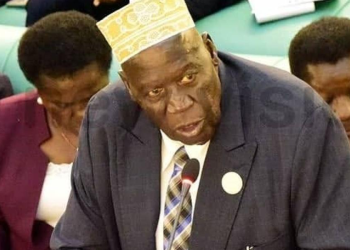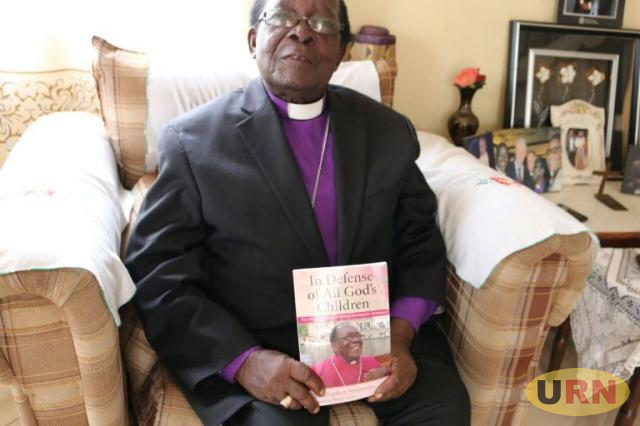
By the time Bishop Christopher Senyonjo died at the age of 94, his name had become inseparable from one of the most divisive debates in the Anglican Church of Uganda. For years, he was branded by critics as the “pro-gay bishop,” a label that ultimately led to his isolation within the church he served for decades. Yet, those who knew him closely insist history has misunderstood the man. Among them is Canon Eric Kasirye, Kampala Capital City Authority chaplain, who believes Bishop Senyonjo’s legacy deserves to be viewed through the lens of compassion rather than controversy.
“He did not promote homosexuality or live as a gay man himself,” Kasirye told Uganda Radio Network in an exclusive interview, saying he couldn’t shy away from truth. “He was married, raised children and lived as a family man. His concern was to minister to people who had been rejected by society and the church and help rehabilitate them.”
Canon Kasirye’s remarks stand in contrast to the caution displayed by many Anglican clergy contacted for comment following the bishop’s death. While some spoke warmly of his decades of ministry, others remained reluctant, believing his refusal to publicly denounce homosexuals overshadowed an otherwise distinguished episcopal career.

According to Canon Eric Kasirye, who repeatedly referred to the late bishop as Taata because he viewed him as a father figure, the story of Senyonjo’s controversial journey began long before he became the public face of the homosexuality debate in the church. While serving as Provincial Youth Secretary around 2000, the then Rev Kasirye encountered young people who identified as gay and were seeking spiritual guidance, then a taboo subject in the church.
“The problem existed,” Canon Kasirye noted looking at the memory lane. “The challenge was that people in the church did not want to acknowledge or talk about it.” Unsure how to handle such a sensitive matter, Kasirye who was relatively young in ministry, turned to Senyonjo, then one of the church’s most respected bishops.
The encounter would later be documented in Senyonjo’s memoir, In Defence of All God’s Children. In the book, the late bishop recalls that in December 2000, Kasirye approached him requesting counselling for several young people who felt marginalized by both church and society. In January the following year, Kasirye brought the group to Senyonjo. “This was my first official encounter with LGBTQ persons in Uganda,” Senyonjo wrote. “On listening to the young men, I realized they were despondent and frightened.”
Kasirye says his decision to refer the youths was deliberate. “I felt the matter required someone at the level of a bishop,” he said. “During my time serving as chaplain to Bishop Samuel Balagadde Ssekkadde, I had seen Bishop Senyonjo as humble, approachable and willing to listen.” That decision to counsel the young men altered the course of Bishop Christopher Senyonjo’s life. In his memoir, Senyonjo explained that his approach was shaped by his understanding of Christ’s ministry.
“Moreover, Jesus’s call to his disciples was to preach the good news of salvation to all without discrimination,” he wrote. “In the Gospel, Jesus reached out to everyone, including the prostitute. I therefore resolved that I could not abandon the LGBTQ community,” he wrote. The decision came at a heavy personal cost. His stance drew fierce opposition within the Anglican Church, leading to his eventual isolation and the withdrawal of his licence to minister.
Reflecting on the fallout, Senyonjo wrote, “…it grieved me deeply that a number of my colleagues and friends furiously turned against me.” His insistence that homosexuals deserved pastoral care rather than condemnation sparked fierce opposition within the Anglican hierarchy. Eventually, he was stripped of his licence to minister after refusing to renounce his position.
However, Kasirye believes the controversy was only part of the story. “There were church politics,” he said. “The homosexuality issue became the weapon some people used against him.” He points to, among other issues, disagreements within the church and the House of Bishops, particularly during episcopal elections, where Senyonjo insisted on following established procedures even when influential figures favoured different outcomes.
He recalled the election of a Bishop Misaeri Kauma-backed candidate in Namirembe, saying Senyonjo opposed attempts to force another contender out of the race to clear the way for the outgoing bishop’s preferred successor. “It was total chaos,” Kasirye said. “They had blackmailed Ssekadde, but Senyonjo stood firm and said if Ssekadde was to lose, let him lose through God’s will, not manipulation.”
For Kasirye, those disagreements, together with other issues he declined to discuss publicly, created powerful enemies who later used the homosexuality controversy to settle old scores with Senyonjo. He added that the controversy also nearly drew him and other priests into the storm after their names became associated with the matter. However, he said he escaped the full force of the backlash because he was not considered the main target, among other factors.Despite the fallout, Kasirye said he never stopped interacting with Senyonjo.
After disciplinary action was taken against him, Senyonjo found himself increasingly isolated. Many clergy he had mentored kept their distance. Yet, according to Kasirye, the retired bishop never responded with bitterness.
“He used to say he would not fight fire with fire but with love,” Kasirye said. Instead, Senyonjo continued visiting bishops and clergy who had opposed him whenever they fell ill. He attended their funerals, comforted grieving families and quietly offered financial support where needed. “I don’t think I would have reacted the way he did,” Kasirye admitted.
Even after losing official recognition, Senyonjo continued dressing in his episcopal shirt and attending services like any ordinary worshipper. At St Andrew’s Church in Bukoto, where he worshipped during retirement, some parishioners initially treated him with suspicion but with time, attitudes softened. “He participated in church activities, contributed financially and even joined the Fathers’ Union,” Kasirye said.
Kasirye however emphasized that long before controversy defined his public image, Senyonjo had built an extensive record of church leadership. For instance, he taught and mentored many priests several of whom later became bishops.
“Bishops such as the late Rt Rev Godfrey Makumbi, West Buganda; Rt Rev George Ssenabulya, the retired Bishop of Central Buganda Diocese; Rt Rev Wilson Mutebi, the retired Bishop of Mityana Diocese; and late Rt Rev Samuel Balagadde Ssekadde, of Namirembe Diocese, were among those he mentored,” Kasirye said. “They used to call him ‘our teacher’ in the House of Bishops. He served as secretary to the House before later becoming its dean.”
Canon Kasirye could not stop praising the departed bishop for the many contributions he made to the church. He noted that Senyonjo played a major role in the revision of the modern Luganda Bible, helping transition the translation from earlier versions that referred to Jesus Christ as “Isa Masiya” to the current usage of “Yesu Kristo.”
In the interview, Kasirye also pointed out that as Bishop of West Buganda, Senyonjo inherited a deeply divided church. The diocese had been torn apart following disputes over relocating the bishop’s residence from Kako to Mityana. Rather than deepen the divisions, he sought structural reforms. “He calmed the diocese,” Kasirye said. “He later proposed dividing the vast diocese into smaller areas. That eventually led to the creation of Mityana Diocese and later Central Buganda Diocese.”
He also spearheaded construction efforts for St Paul’s Cathedral at Kako, transforming what had remained largely an aspiration into reality. Evangelising in West Buganda was never easy as the region had a strong Roman Catholic presence, while Anglican congregations had weakened following years of internal divisions. Kasirye credits Senyonjo with restoring confidence in the diocese and strengthening Anglican ministry in the region.
Unlike many retired bishops who remain within their former dioceses, Senyonjo chose to settle in Kampala’s Bukoto suburb. “When asked why, he offered a simple answer,” Kasirye recalls. “He told me remaining there would make it difficult for the new bishop to lead because people would continue the successors in the shadow of the retired bishop.” Even in retirement, he remained available whenever the Diocese of Namirembe requested his help.
Kasirye, then chaplain to Bishop Samuel Balagadde Ssekadde, often coordinated those assignments. “I would call him whenever the bishop needed someone to represent him, and he never hesitated.”
Kasirye said Senyonjo’s humility became legendary. Despite serving as a bishop for nearly a quarter of a century, he never owned a personal car. Even when invited to preside over episcopal functions, he travelled by public taxis, carrying himself with the same simplicity that defined his ministry.
Kasirye recalls one memorable visit to St John’s Church in Entebbe where the congregation stood waiting for the bishop’s arrival when a taxi stopped at the church gate.
“They almost chased the taxi away,” Kasirye recalled with a laugh. “We had not informed them that Bishop Ssekadde would not be coming and that Bishop Senyonjo would preside instead. Then Bishop Senyonjo stepped out, carrying nothing more than a small polythene bag.” The unexpected arrival left the congregation momentarily stunned. “They stood in silence for a few seconds, then broke into applause as they welcomed him to confirm the children.”
For Canon Kasirye, although church leaders were deeply opposed to Senyonjo’s position in the early 2000s, relations between the retired bishop and sections of the Anglican Church gradually improved over the years.
Kasirye recalls the emotional reception Senyonjo received during prayers for the late Bishop Ssekadde at Namirembe Cathedral, where the congregation welcomed him warmly after years of distance.
“The archbishop announced his presence and the entire congregation rose to applaud him.” He added that when his wife Mary passed away in 2021, West Buganda Diocese requested that she be buried at St Paul’s Cathedral Kako, a place Senyonjo worked hard to establish. But Mary had wished to be buried in Singo, and the bishop chose to honour her final request rather than accept the proposal.
A memorial service for Mary was held at St Andrew’s Church in Bukoto before her burial in Singo. The burial was attended by three bishops: Bishop Henry Katumba Tamale, the then Bishop of West Buganda Diocese; Bishop George Ssenabulya, the retired Bishop of Central Buganda Diocese; and Rt Rev Wilson Mutebi, the retired Bishop of Mityana Diocese.
In 2025, Senyonjo was invited to the consecration of the seventh Bishop of West Buganda, which surprised him because for some time he had not been invited to such a function. He gladly attended and later told me that the current bishop, Gaster Nsereko, was a good and kind man,” Kasirye said. For Kasirye, those moments suggested the church had begun to reconcile with one of its most controversial sons.
“They misunderstood him,” Kasirye says. “People remembered the controversy but forgot the priest, the teacher, the mentor and the bishop who gave his entire life to serving the Church.”-URN. Give us feedback on this story through our email: kamwokyatimes@gmail.com