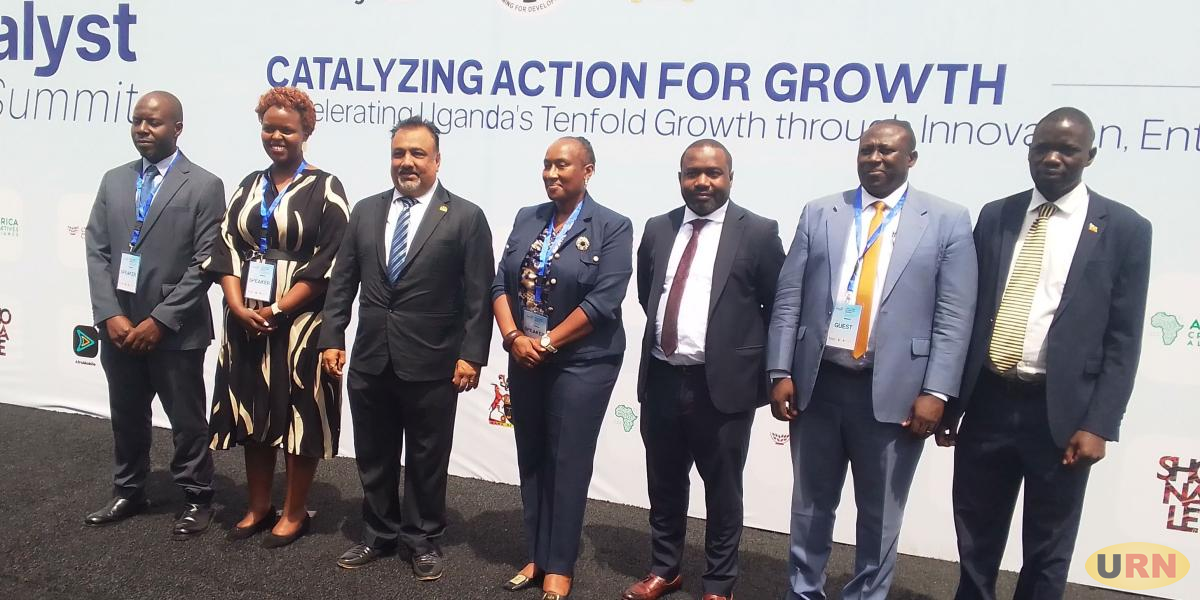
The government has pledged commitment to support micro, small, and medium enterprises (MSMEs) as a key driver to attaining the 10-fold economic growth. Speaking at the UG Catalyst Summit on Thursday, Sanjay Tana, the Minister of Trade, Industry, and Cooperatives, said that the government has intensified its focus on supporting the private sector as a key driver of economic growth with plans aimed at improving the survival and growth of businesses across the country.
“There is the 10-fold growth strategy that we are trying to achieve, there are various initiatives, and we want to align and encourage MSMEs to support us in achieving this growth.” He spoke. The minister, however, noted that the government remains open to ideas from the private sector and other stakeholders, noting that forums such as the UG Catalyst Summit are important in helping the government improve existing programmes.
Asuman Guloba, Director of Development Planning at the National Planning Authority, said the country’s planning framework under the recently concluded National Development Plan IV (NDP IV) is designed to support Uganda’s transition under the government’s 10-fold growth strategy. Guloba noted that while Ugandans are widely recognized for their entrepreneurial spirit, many startups fail within their first year of operation. “Currently, over nine out of the ten that start collapse, so we want to change that to at least six of the ten that start surviving,” Guloba said.

Under the new strategy, government agencies are being urged to shift from a punitive regulatory approach to one that supports businesses to remain operational and compliant. He cited agencies such as the National Environment Management Authority (NEMA), the Uganda National Bureau of Standards (UNBS), and the Uganda Revenue Authority (URA), saying they should prioritize helping businesses meet regulations instead of rushing to close them.
Guloba noted that achieving the ambitious targets requires moving beyond business as usual and placing the private sector at the centre of national development efforts. He explained that the summit provides a platform for the government to engage directly with private sector actors, outline priority investment areas, and highlight opportunities embedded in national development plans.
According to Guloba, key focus areas for investment include agro-industrialisation, tourism, minerals, and science and innovation, commonly referred to as the ATMS strategy pillars. These sectors are expected to drive inclusive growth, industrial expansion, and job creation as Uganda seeks to accelerate economic transformation, Goloba explained.
Rita Ngenzi, Executive Director of Innovation Village Hub, speaking to URN on the sidelines, said that the Innovation Village has supported over 300,000 youth primarily between the ages of 18 and 35 through centres in Kampala, Mbarara, Jinja, and Gulu. She explained that the organisation provides shared equipment, workspaces, and both physical and digital marketplaces, with most costs subsidized through private partners.
Ngenzi said the goal is to grow that number to at least one million young people but emphasized that achieving it would require sustained government involvement. She also noted that young entrepreneurs accessing Innovation Village’s services have cited access to markets, financing, equipment, and digital infrastructure as their most pressing needs. The MoTIV facility is envisioned as a model mini-industrial park for MSMEs, a concept it hopes to replicate more broadly across the country-URN. Give us feedback on this story through our email: kamwokyatimes@gmail.com