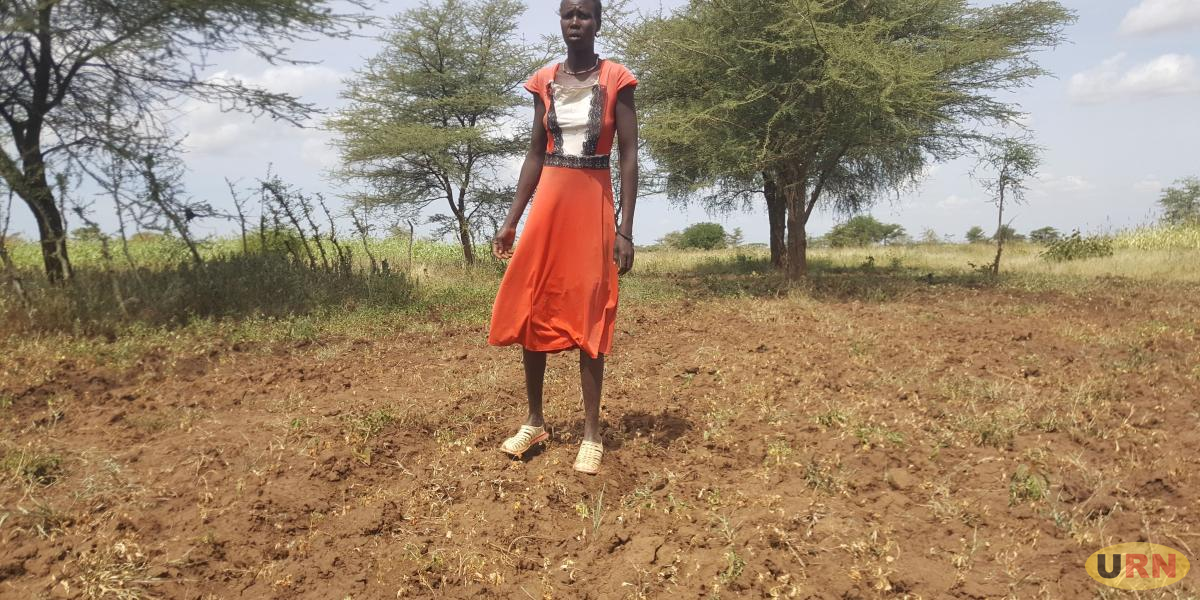
Families across Karamoja are abandoning farmlands for gold and quarry mining sites as a month-long dry spell wipes out gardens, pushing the sub-region toward a serious hunger crisis. The scorching sun has destroyed all the crops planted, shattering hopes for this season’s harvest. With food prices doubling in markets, households say mining wages are now their only survival option.
Mary Nachap, a mother of five from Rupa Sub-County, told URN reporter at a gold mining site that she fled home after all her crops dried before flowering. “I planted 3 acres of sorghum mixed with beans expecting a bumper harvest, but all have dried before flowering. By now, I would be harvesting beans, but the heat affected it, and it’s all dry,” Nachap said. She now earns between 2,000 and 3,000 shillings a day at the mine.
“High food prices have also affected me. I often buy malwa residue, measured with a water jug at 500 shillings, and I need four to feed the entire family,” she said.

Lucy Lorot, a resident of Namalera Village, Lotisan Sub-County, shared the same frustration, stating that the beans, maize, and simsim she planted have all dried up. “There is no single hope for replanting because the scorching sun is still intensifying. Now we are trying quarry stone sites to make money for food,” Lorot said.
Lorot said they ahave been to seek casual work at stone quarry so as to earn a living. She appealed to the government to send them food aid saying the money they earn from mining sites cannot sustain them.
Jackson Angella Adome, an elder in Moroto, said this is the worst dry spell since droughts between 1945 and 1980 that claimed many lives. He said the state of the gardens gives no hope for the future, and what is expected is only a serious hunger crisis. He stressed that people tried planting crops, but the weather changed abruptly and wiped out all the gardens. He noted that although sorghum is resistant, the prolonged drought will destroy everything, and it will not survive.
Adome warned that if the problem of food insecurity is not addressed now, many people could die of hunger, more than in previous years. He warned that pastoralists may be forced into Teso areas in search of pasture and water, a migration likely to trigger conflicts over resources.
Stephanie Adupa, the Moroto District Vice Chairperson, said the situation in Tapac Sub-County is alarming because the community there grows only maize.
Adupa said that unlike crops like sorghum, maize dries up completely, and once it is affected by heat, it does not recover even when rains return. She observed that hunger started affecting the community in December last year, and they expected this season’s harvest to save them, but unfortunately, their efforts have been in vain. She said communities, including children who should be in school, have now turned to mining sites.
Adupa said that while communities are resorting to mining, they face various challenges at the mines, including sexual harassment, lack of protective gear, exploitation, and others. Adupa stressed that women and girls have been sexually abused but do not report it because they are struggling to survive.
Joseph Otita, the LC3 Chairperson of Rupa Sub-County, warned that people will suffer for another year without food.
Otita said the season has been wasted, including in green-belt areas that have failed this time. He noted they are now stuck, and pastoralists are equally affected because there is no water for animals. He expressed fear that when migration resumes in the region, it is likely to escalate insecurity and slow economic transformation as productive people flee their homes to survive.
Otita stressed that they have long asked the government to provide water for production, but in vain, and now there is no water catchment point to save them. He said a dam like Kobebe would help pastoralists, but the government has abandoned it, and the dam is silted and cannot store water.
Otita observed that people have already abandoned their homes and gone to mining areas to survive. He said people walk over 40 kilometers to the mining site daily for very little money that cannot feed a family.
Betty Chalein, Amudat District Female Councillor for Persons with Disabilities, warned that the crisis could trigger insecurity, domestic violence, and suicidal cases. “Vulnerable people like the elderly and persons with disability are often abandoned as others migrate for food,” Chalein said. She said pastoralists have started moving livestock toward Nakapiripirit and Nabilatuk, calling for security vigilance.
Meteorological authorities say rains are expected to return to Karamoja in mid-June with intermittent showers through August. The region’s unimodal pattern usually peaks in April-May, then breaks in June before resuming in July-August. But leaders warn that if the rains fail to return within a week, the region faces disaster.
“We expect more hunger-related deaths as families completely lack what to eat,” Otita said. A spot check by our reporter in the market found that maize cereals, which are largely bought for ugali, have doubled from 3,000 to 7,000 shillings a can.
A can is a container that measures about 2 kilograms and is widely used for measuring cereals such as sorghum and maize in markets across the Karamoja sub-region. With lower yields from regions such as Elgon and Sebei that used to supply the grains, prices have risen due to high reliance on outside traders who are also experiencing low yields due to scorching sun-URN. Give us feedback on this story through our email: kamwokyatimes@gmail.com