Millions of Ugandan households could remain dependent on firewood and charcoal despite the government’s planned expansion of electricity generation unless cleaner cooking alternatives become more affordable and accessible.
State Minister for Energy Sidronious Okaasai Opolot has warned that continued reliance on traditional biomass fuels carries environmental and public health costs, particularly for women and children, while putting pressure on household resources.
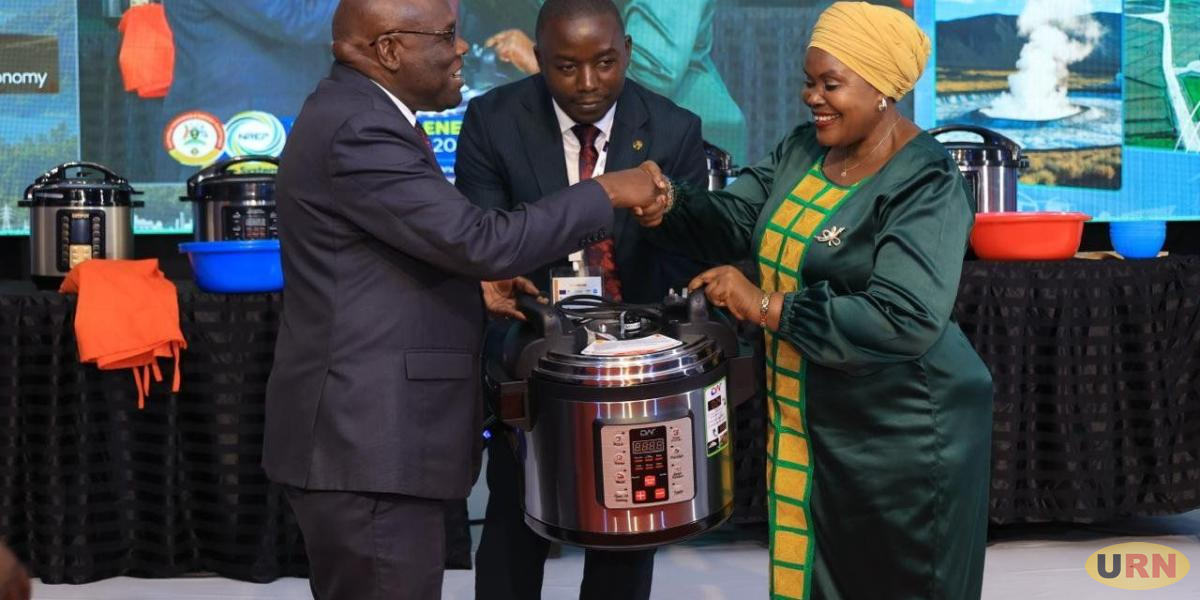
Speaking at the Renewable Energy Conference and Expo 2026 in Kampala, Opolot called for greater investment in electric cooking, liquefied petroleum gas (LPG), ethanol, biogas and improved biomass technologies, backed by financing that enables households and public institutions to adopt cleaner alternatives.

“Solutions must include electric cooking, LPG, ethanol, biogas and improved biomass technologies, supported by financing models that reach ordinary households and public institutions,” he said.
The challenge, however, is whether households can afford the fuels, appliances and infrastructure needed to make the switch.
Electric cooking requires suitable appliances and reliable electricity connections. LPG users must pay for stoves, cylinders and refills, while ethanol depends on affordable fuel and accessible distribution networks. Biogas systems require investment in installation and maintenance.
For low-income households already struggling to pay for food, school fees, healthcare and transport, these costs can make switching fuels difficult even when cleaner technologies are available.
The affordability question has also surfaced in Parliament, where Speaker Jacob Markson Oboth suspended enforcement of the charcoal trade ban under Presidential Executive Order No. 3 of 2023 on Wednesday, October 14, pending a government statement on alternative energy sources.
The restrictions cover West Nile, Northern Uganda, Karamoja and Teso.
Leader of the Opposition Joel Ssenyonyi cited Uganda Bureau of Statistics data indicating that between 87 and 94 per cent of Ugandans still rely on firewood and charcoal, raising questions about the affordability and accessibility of alternatives.
Other legislators raised concerns about the effects of abrupt enforcement on restaurants, employment and the legality of the restrictions.
Restricting traditional fuels without providing practical and affordable alternatives risks imposing additional costs on households and businesses with limited capacity to switch.
At the conference’s closing session at Serena Hotel on Thursday, Energy Minister Dr Monica Musenero Masanza said Uganda must assess energy investments by the economic and social benefits they generate, rather than infrastructure development alone.
She said the conference theme, “From Systems to Scale: Transforming Uganda’s Green Economy,” aligns with the Fourth National Development Plan (NDP IV), covering the 2025/26–2029/30 period, and the government’s Ten-Fold Growth Strategy.“Energy is not simply another service delivered by Government. It is a fundamental input into agriculture, manufacturing, mining, transport, tourism, digital transformation and virtually every productive activity,” Musenero said.
“We must position the energy sector as a direct driver of industrialisation and wealth creation,”Musenero said progress should be measured by the industries established, jobs created, productivity improved and value retained in Uganda, rather than solely by installed generation capacity and transmission infrastructure.
Uganda plans to increase electricity generation capacity to approximately 15,420 megawatts by 2030 and 52,000 megawatts by 2040, drawing on hydropower, solar, geothermal, nuclear and other sources, alongside expanded transmission and distribution networks-URN. Give us feedback on this story through our email: kamwokyatimes@gmail.com