By KT Reporter
In the quiet border district of Lamwo, where memories of cattle raids and sporadic violence still linger, an unusual procession crossed from South Sudan into Uganda on Thursday, not soldiers or traders, but choirs, clergy, and faithful carrying a message of peace.
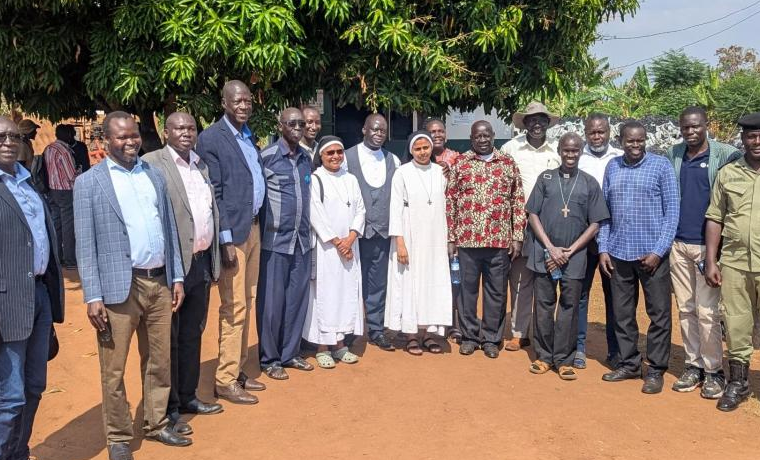
More than 100 Catholics from the Catholic Diocese of Torit arrived for a pastoral visit aimed at healing strained relations between border communities. Their itinerary is to pray together, sing together, and engage leaders on how to build a safer future.

For communities long divided by insecurity, the visit comes as a deliberate shift from suspicion to solidarity. Monsignor Peter Ben-Louis described the initiative as deeply personal, shaped by ties that stretch beyond geography.
“I am one of the products of this nation. Most of my studies were done here in Uganda,” he said. “Based on that experience, we said, why don’t we make this collaboration, to come together, pray together, and share.”
The idea gained momentum with encouragement from John Baptist Odama, the Archbishop Emeritus of the Roman Catholic Archdiocese of Gulu, who urged younger clergy to undertake cross-border pastoral visits as a practical way to ease tensions.
What began as a modest parish invitation last year, when Holy Rosary Parish hosted Christ the King Parish, has since grown into a structured exchange featuring return visits, joint liturgies, and vibrant choir performances on both sides of the border.
Ben-Louis noted that Music has proven especially powerful, strengthening relationships between congregations while improving liturgical practice in Torit through training support from Ugandan instructors. He said the partnership between choirs demonstrates how music can be used as a tool for reconciliation.
Msgr Ben-Louis expressed hope that continued collaboration between the choirs will further improve relations between the two nations, noting that music has historically been used to preach peace and unity.
Using the occasion to appeal for calm along the Uganda-South Sudan frontier, he warned against the devastating cost of conflict.
“There is nothing more important than living in peace,” he said, reflecting on his experience during South Sudan’s liberation struggle. “I don’t want anybody to enter into the experience that we went through.”
Describing the two nations as sister countries, he urged border communities to reject violence and instead embrace coexistence and economic cooperation.
Local leaders see the church-led effort as reinforcing ongoing attempts to stabilise the frontier. James Ochola, the Speaker of the Lamwo District Council and coordinator of the pastoral tour, said the visit complements efforts to address insecurity while rebuilding trust between communities often divided by cattle theft.
“The purpose of this visit is to create unity, especially at the border, where communities have been at loggerheads due to cattle raiding,” Ochola said. He added that cross-border peace prayers, first held in 2024 in Madi-Opei, have already helped open dialogue between political and religious leaders. Discussions now include reopening key roads to boost trade and encourage shared prosperity.
From the South Sudanese delegation, Charles Oduar Okech, Speaker of the Eastern Equatorial Legislative Assembly, said the visit responds to an invitation from Ugandan counterparts to deepen cooperation through faith and dialogue.
“We are here to share the message of God and also to engage government officials on cross-border peace,” he said. Responding to concerns about insecurity, Okech described recent cattle theft incidents as isolated criminal acts, adding that authorities have identified suspects and deployed security forces to pursue armed raiders and recover stolen animals.
For many participants, however, the strongest argument for peace lies in shared identity rather than policy.
Choir director Geoffrey Vinaysa Lam said the initiative brings out the deep cultural and linguistic ties shared by communities on both sides of the border, noting that the only real separation between them is a colonial boundary.
He emphasised that sustained exchange visits and annual cross-border peace prayers are essential to fostering understanding, strengthening relationships, and ultimately bringing an end to cycles of violence.
Church leaders say plans include expanded pilgrimages, sustained peace prayers, and broader participation from parish groups, among them choirs, the Legion of Mary, charismatic movements, and other devotional associations, ensuring the peace effort is rooted in everyday community life.
The delegation is scheduled to visit Gulu today, before conducting fellowship visits in Pader and Agago districts on January 31, and later returning to South Sudan via the Ngomoromo-Pogee border.
-URN. Give us feedback on this story through our email: kamwokyatimes@gmail.com