Artists, researchers and conservationists say the future of Uganda’s traditional barkcloth (lubugo) depends on deeper research, greater value addition into new products, and the large-scale planting of mutuba trees.
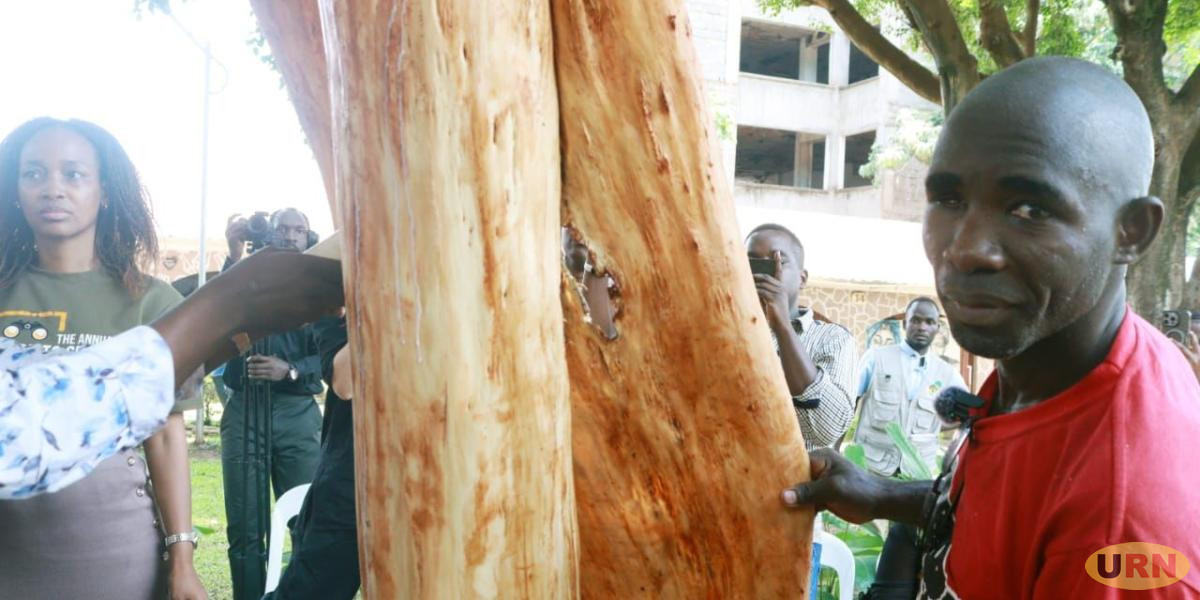
The obervations were made on Friday at the National Theatre during a public demonstration of the full production process of barkcloth by National Arts and Cultural Crafts Association of Uganda (NACCAU).
Artist and researcher Fred Mutebi, who has worked with barkcloth for years and is studying it as both a traditional material and a contemporary art medium, said the fabric still sits largely where the forefathers left it, despite its high potential.

“We have a material that can compete on the global stage, yet we have done almost nothing to take it beyond the level our ancestors left it. The knowledge is there, the tree is there, the market is opening. what is missing is deliberate research, value addition and the will to treat it as a serious economic resource,” Mutebi said.
Barkcloth, beaten from the inner bark of the mutuba tree (Ficus natalensis), is one of Uganda’s oldest textile materials. A single tree can be harvested repeatedly for decades if properly managed, making the material renewable. Yet promoters note that the number of mature mutuba trees has declined over many areas, limiting supply and driving up costs.
Mutebi said the lubugo craft must be propelled into the money economy through grading, standardisation and value addition depending on the intended use.
Uganda already has a draft national standard (DUS 2551: 2021) setting measurable requirements for mutuba barkcloth, including mass per unit area, thickness, porosity and colour fastness. Promoters say applying these standards in everyday commerce through grading would allow the fabric to be properly valued and sold.
UNESCO proclaimed barkcloth making a Masterpiece of the Oral and Intangible Heritage of Humanity in 2005 and inscribed it on the Representative List in 2008. The craft, traditionally associated with the Ngonge clan of Buganda, involves harvesting the inner bark during the rainy seasons without killing the tree. The trunk is wrapped in banana leaves so the bark regenerates, allowing repeated harvests over decades.
Nuwa Wamala Nnyanzi, a renowned artist and cultural enthusiast, also one of the organisers of the demonstration, said researchers are increasingly studying barkcloth as both an art medium and a fabric. He credited Mutebi for developing a canvas from an intermediate stage of the beating process.
“Mutebi is working on a canvas obtained before the lubugo as we know it. There are also other experiments on preservation and new colouring methods, such as soaking the cloth in iron-rich clay to achieve darker shades, among others,” he said, describing the barkcloth as a wonder fabric.
For years the fabric was strongly associated with burial rites and largely overlooked commercially. Since the UNESCO recognition, artists and designers in Uganda and abroad have developed handbags, hats, purses, fashion garments, wall hangings, accessories and artworks.
Beyond simple value addition, Mutebi said other local and international research efforts are under way, including designers combining barkcloth with kitenge fabric. He added that Adidas once visited Uganda to explore using the fabric in shoes.
Mutebi, an artist himself, could not resist making the case for lubugo, which he described as one of the best high-quality mediums. Paintings on barkcloth, he said, can fetch many times the price of those on ordinary canvas because of the story and the material behind them.
Attendees’ voices
Esther Goossens, an artist who has used lubugo as a canvas for about 20 years, attended to witness the process and learn how to clean the fabric when stained. Her interest reflects a growing need for practical knowledge about caring for barkcloth products as their use expands beyond traditional settings.
Anthony Onama, artist and product developer, said growing client demand for barkcloth products had pushed him to understand the material better, including how it is made and how it behaves in different products.
Rosey Sembatya, a teacher and member of the Ngonge clan, the traditional custodians of barkcloth-making, said she had never witnessed the entire process despite her clan’s historical responsibility for the craft. She owns several barkcloth items, including purses, and takes pride in the material.
Sembatya welcomed efforts to turn barkcloth into everyday products, arguing that wider use would help challenge negative associations some people attach to it, including links to death and witchcraft.
“I am particularly pleased to see dolls made from barkcloth. Early exposure would help children grow familiar with the fabric and appreciate its cultural value without fear or prejudice,” she noted.
Other speakers called for a deliberate campaign to change attitudes towards barkcloth. They urged musicians, advertisers, schools, churches and cultural institutions to promote its use and broaden public understanding.
Dr Christian Kadama of the PKS Foundation in Namutamba, Mityana District, turned attention to conserving the mutuba tree. Her foundation began using barkcloth to train village mothers in simple crafts, an initiative through which she developed a deeper appreciation of the material.
“Conserving barkcloth starts with conserving the mutuba tree. If we do not protect the tree and plant more of them, we risk losing the raw material needed to sustain this craft. We need to encourage more people to grow mutuba trees so that future generations can continue making barkcloth and benefit from its cultural and economic value,” she said.
Mutebi also stressed expanding mutuba cultivation as demand grows. He said the tree offers benefits beyond barkcloth, including medicinal uses and animal feed, and urged government to support its cultivation as part of wider tree-planting programmes.
“Instead of concentrating on planting eucalyptus, government should also support the planting of mutuba trees in large numbers. Even someone who plants five trees is contributing, while those who plant thousands or millions would make an even greater difference,” he said.
He added that sustaining the craft requires training a new generation of artisans. Barkcloth-making was traditionally passed down through family apprenticeships, but some young people have become reluctant to learn the skill, threatening its continuity.
To address this, Mutebi said they had established a training centre in Bukomansimbi, where barkcloth-making remains part of local heritage. The centre trains aspiring artisans, while growing commercial interest is beginning to attract young people who see a way to earn a living.
NACCAU has made barkcloth promotion an annual effort, with this year marking the fifth consecutive year of live demonstrations. The demonstration used a mutuba tree planted in the organisation’s compound eight years ago for the purpose.
Attendees watched with keen interest, and some took part in different stages of the process, gaining first-hand experience of how the fabric is produced. Many rushed to take selfies to freeze the memory-URN. Give us feedback on this story through our email: kamwokyatimes@gmail.com