By KT Reporter
Regional Civil Society organisations are calling on governments in Africa to strengthen their stances in the wake of rising international trade barriers.
The continent is facing several challenges induced by development partners and export markets, especially in the developed world, making trade, especially in commodities, harder.

Amidst rising interest rates, dwindling external financing sources, and a rising debt burden, the US and the European Union are tightening trade barriers through higher tariffs and non-tariff trade directives, respectively.
The CSOs are particularly concerned that frameworks like the European Union Deforestation Regulation, the Green Deal, the Directive on corporate sustainability due diligence, EU Carbon Border Adjustment Mechanism and others are coming at a time when the developing world is already reeling in debt; growing scarcity of patient capital; and record tariffs by the US government on Africa’s commodity exports.
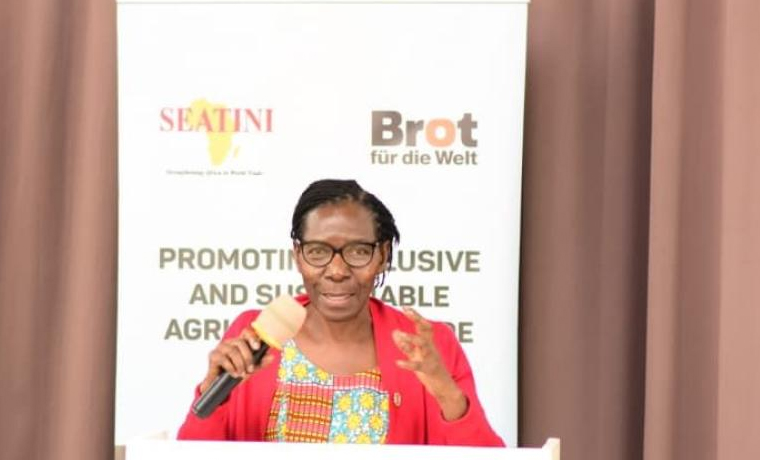
Jane Nalunga, SEATINI Uganda Executive Director, say all these regulations are targeting agro production and agro trade, which are the backbone of Uganda and most African countries.
She emphasises that Africa is not against sustainability or addressing climate change, since “Africans live close to nature and are already experiencing the climate crisis”, but the concern is about the unilateral and rigid approach of the EU measures.
The directives, she says, are being introduced in a difficult global context with trade tensions, tariffs, reduced aid, rising loans, debt burdens, and domestic resource mobilisation struggles.
According to her, the directives are seen as unilateral measures imposed by the EU, unlike the past negotiated trade relationships, and this undermines inclusivity in global trade governance.
She was speaking at a Regional High-Level Dialogue in Nairobi to reassess the impacts of EU trade policies on African agriculture, organised by the Southern and Eastern Africa Trade Information and Negotiations Institute (SEATINI), Econews Africa and the East African Trade Network.
Olivia Costa, Executive Director, Tanzania Trade and Investment Coalition, cautioned that relying solely on EU funding risks undermining Africa’s autonomy; mobilising local resources is key to ensuring independence in shaping trade positions.
“Africa must define its position and narrative before negotiations, recognising the value of its resources as leverage in trade talks,” she says, adding that the EU policies impose uniform deadlines that do not reflect Africa’s diverse production realities, especially the stallholder dominance.
“Countries and smallholders need more time to transition. Compliance costs are high and threaten small-scale farmers whose agriculture is their livelihood, unlike large-scale producers who can afford it.”
There is a worry that the negotiations with the West hardly take into account the views or contributions of the smallholder farmers and enterprises, despite them being an important segment of the economies.
Francine Rutazana, Chairperson of the EAC Legislative Assembly Committee on Communications, Trade, and Investment, says since negotiations are led by governments, they should ensure that the voices and concerns of farmers and cooperatives are integrated into national positions before moving to the regional level.
She also reiterated that there is no interest in quitting trading with the EU but that the continent must demand equity.
“We are not ready unless you negotiate with us fairly. By setting conditions, Africa can safeguard its interests while ensuring that trade remains mutually beneficial,” she says, calling on regional blocs like EAC, SADC and ECOWAS, to align and present a single, unified voice when engaging with the European Union, for a better bargaining power.
Her sentiments were reechoed by Franciose Uwumukiza, another EALA MP, who says that African countries cannot quit the EU market but must seek practical solutions, synergies, and support to remain competitive while safeguarding smallholder farmers.
“The EU’s unilateral approach ignores African input; African stakeholders must push for equity and inclusivity in global trade rules. Smallholder farmers require training, awareness, and support to understand and implement compliance requirements effectively,” he says.
Kemigisha Marcy, manager of Green Coffee at NUCAFE Commodities, says smallholder farmers, who mostly farm on one acre for subsistence, cannot afford the costs of meeting EU Deforestation Regulation (EUDR) requirements.
Some of the tools needed to ease compliance, including smartphones and tools to collect geo-points and polygons, they are unaffordable by farmers, making compliance data collection slow, expensive, and difficult.
Kemigisha proposes that Uganda and Africa should not only depend on EU directives and donor funding but also develop their policies and better ways of trading in commodities.
Edgar Odari, Executive Director, ECO NEWS Africa, says that Africa often accepts EU-prepared texts in negotiations instead of bringing its proposals, leaving Africans as passive rule-takers rather than active standard-setters. In the end, this also leads to the acceptance of treaties which at times harbour undesirable clauses.
“While liberalisation is presented as a solution, EU sanitary and sustainability standards (e.g., methyl bromide treatment, deep-freezing requirements) act as hidden barriers to African exports,” he says.
In effect, sustainability and due diligence directives, though well-intentioned, often transfer high compliance costs onto African farmers, who already earn very little from value chains like coffee, he adds.
The need for Africa’s own trade and investment deals as a solution to counter the EU deals was also voiced, based on what India and China are doing. “Africa should not wait for EU rulings but proactively develop its own ‘African Green Deal,’ pursue mutual recognition agreements with the EU, and diversify export markets with support from International Trade Centre (ITC),” says Christian Häberli, Fellow at the World Trade Institute.
He says the measures affect the entire food value chain, from farm-gate to consumer, with higher compliance burdens especially for exporters and SMEs.
The Green Deal is creating a “fortress” Europe that eases life for EU importers while imposing heavy compliance barriers on suppliers and exporters from Africa and other regions, according to Häberli.
The EU Green Deal is a package of over 50 regulations and directives, aiming for climate neutrality by 2050, with key measures such as the CBAM and the EUDR.
“There are no sustainability impact assessments for the effects of these measures on trade and third countries, especially African exporters,” he says, noting that these measures are unilateral, defined in Brussels, and not negotiated multilaterally.
-URN. Give us feedback on this story through our email: kamwokyatimes@gmail.com