By KT Reporter
Local leaders across the Karamoja sub-region are expressing a mix of hope and apprehension regarding the introduction of Biometric Voter Verification Kits (BVVKs) by the Electoral Commission (EC), just four days ahead of the general elections slated for January 15th.
While acknowledging the potential for enhanced electoral integrity, many are concerned about the late sensitization and potential operational issues with the new technology.

The Electoral Commission plans to deploy two BVVKs at each of the 50,739 polling stations nationwide, including all 109,142 procured units, as an upgrade from previous systems used in 2016 and 2021.
These kits, preloaded with voter data, are intended to prevent ballot manipulation by verifying voters’ identities, with polling agents witnessing their initial setup to ensure no tampering.
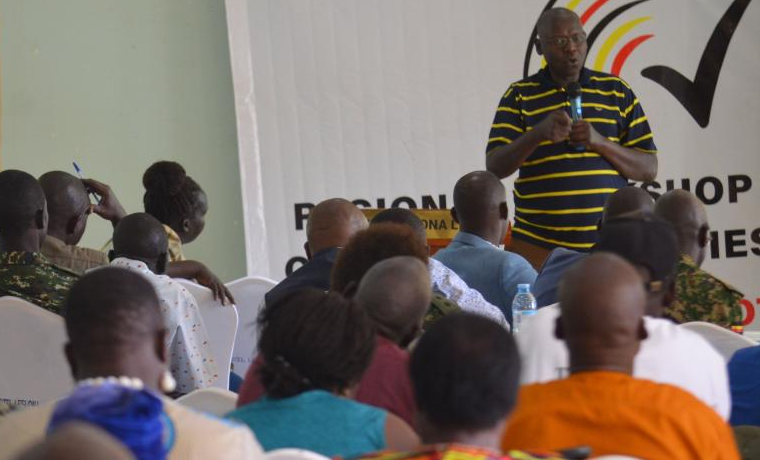
However, a regional stakeholders’ sensitization workshop organized by the EC on Friday revealed significant anxieties.
Gaston John Napakol, the councilor representing people with disabilities in Moroto district, voiced concerns about the BVVKs’ reliability.
“The machines are worrying us because there is a tendency of a system to deny someone’s thumbprints,” Napakol stated, urging for thorough verification to assure error-free operation.
He also criticized the timing, noting that four days is insufficient for communities to familiarize themselves with the technology, suggesting the kits should have been introduced to parishes at least two weeks prior.
Jackson Angella, a Moroto elder, echoed the sentiment regarding untimely training. He pointed out that civic education on the BVVKs has primarily benefited workshop attendees, leaving the majority of voters uninformed about the machines’ purpose.
Angella believes earlier integration of the BVVKs into grassroots voter education would have been more effective, suggesting that polling station officials will now bear the burden of explaining the technology to voters.
Despite his concerns, Angella acknowledged the EC’s wisdom in introducing the machines to avert electoral malpractices.
Conversely, some leaders expressed optimism. Meri Jino, the LC5 chairperson of Kaabong district and a contestant for Dodoth East Constituency, hailed the BVVKs as “central and key” to the polling day.
Jino expressed confidence that the kits would effectively combat ballot stuffing, rigging, and collusion among polling officials to manipulate results.
He lauded the EC’s measures to curb irregularities and pledged to sensitize the public on peaceful voting during his final campaign days.
Felix Mark Lochale, LC5 chairperson of Karenga district and a candidate for Dodoth West Constituency, raised a critical operational concern about the contingency plan if both BVVKs at a polling station fail.
He noted that officials indicated that if both machines malfunction, the exercise would halt, and only votes cast up to that point would be counted, a policy he deemed unfair.
Lochale urged for robust BVVK functionality to ensure everyone can vote and anticipated potential bureaucratic hurdles during vote counting.
He called for unbiased operation of the machines to ensure transparency, confirming that his voters are mobilized and ready for Election Day.
Meanwhile, Fr. Paul Ngole, the Vicar General at Moroto Catholic Diocese, brought up a long-standing issue: the alleged manipulation of elections by security forces, specifically the UPDF 3rd division.
Ngole stated that voters often perceive election outcomes as being determined by UPDF leadership, fostering fear. He directly challenged the EC to explain why polling stations were historically established within military installations.
In response, Linos Okori, the Karamoja Regional Election Officer, refuted claims of polling stations being located inside military installations, asserting that all such stations have been removed.
Okori clarified that all UPDF personnel registered to vote would cast their ballots at polling stations within villages.
He urged the public to report any electoral irregularities, emphasizing the importance of capturing evidence, such as videos, to substantiate claims, as many reports are often based on unsubstantiated rumors.
-URN. Give us feedback on this story through our email: kamwokyatimes@gmail.com