By KT Reporter
For nearly six decades, worshippers entering St Mary’s Cathedral Lubaga were met by a raised tomb behind the choir on the church’s right wing.
Enclosed by a rail and capped with a white marble reliquary edged in cream, the grave marked the resting place of Archbishop Joseph Nakabaale Kiwanuka—Africa’s first Archbishop south of the Sahara and one of the most consequential figures in Uganda’s Catholic history.

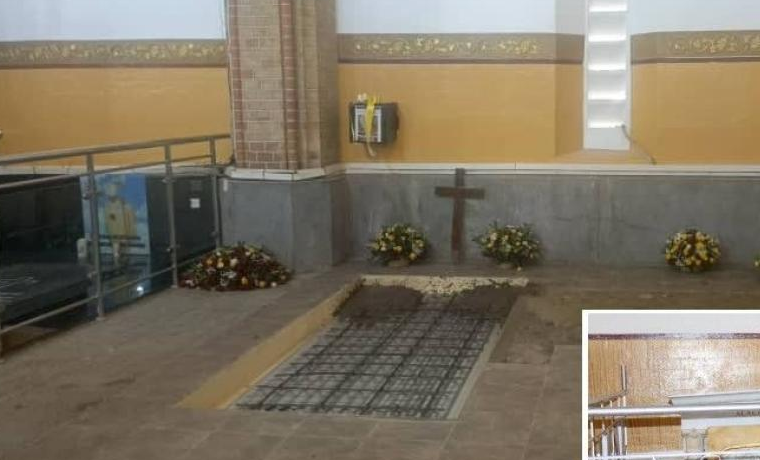
This week, that familiar landmark was quietly opened and carefully repositioned. Church authorities say the move is part of a broader reorganisation of burial sites within Lubaga Cathedral, driven by ongoing renovations and preparations for the cathedral’s centenary celebrations.
On Wednesday evening, Archbishop Paul Ssemogerere led a requiem Mass and presided over the reburial of Archbishop Kiwanuka’s remains, relocating the tomb only a few inches from its original position. Yet the symbolic weight of the act far exceeded the physical distance moved.
careful reopening of history Rev Fr Richard Nyombi, a church historian and parish priest at Nabulagala, said the grave was opened on Sunday under the Archbishop’s guidance.
The intention, he explained, was not exhumation for removal elsewhere, but alignment—bringing historic tombs into a coherent layout that respects both liturgical function and heritage considerations.
“When the coffin was opened, the body was found intact,” Fr Nyombi said, noting that this mirrored observations made in 1994, when church authorities permanently sealed the coffin. While episcopal vestments had deteriorated over time, the remains themselves had not.
On Wednesday, the revered prelate’s remains were placed in a wooden coffin and transferred to the newly prepared resting place. The ceremony was marked by restraint and solemnity, in contrast to the vast crowds that accompanied his burial in 1966.
White vestments and resurrection hope
During the requiem Mass, Archbishop Ssemogerere drew attention to a detail that had puzzled some worshippers: the use of white vestments, despite the liturgical season traditionally associated with purple. White, he explained in his homily, symbolised Christian hope in the resurrection.
“This is not a denial of grief,” he said, “but a proclamation of faith—that death does not have the final word.” He praised Archbishop Kiwanuka as a visionary churchman whose ideas often ran ahead of his time, leaving him misunderstood during his lifetime but vindicated by history.
His service, the Archbishop said, extended beyond ecclesiastical leadership to shaping the moral and intellectual foundations of the nation. Archbishop Kiwanuka died in 1966, but his appointment as Archbishop of Rubaga had already marked a turning point in Uganda’s Catholic journey, inspiring African clergy across the continent and redefining leadership in a church long dominated by missionary bishops.
For decades after his death, Archbishop Kiwanuka’s tomb inside Lubaga Cathedral became both a national and spiritual landmark. Positioned near the Uganda Martyrs’ Altar, the raised grave bore inscriptions detailing his life and calling for prayers for his soul.
The marble reliquary itself was imported from Italy, underscoring the esteem in which he was held. Fr Nyombi recalls that from 1966 until 1994, the faithful could view the Archbishop’s body, dressed in episcopal vestments. The Uganda Episcopal Conference later ordered the coffin permanently sealed, ending public viewing.
Records by historian Robert Ssempa show that the Lubaga Cathedral National Foundation oversaw the original tomb works, led by Henry Kibirige, with construction by architect Kagimu.
burial rites in 1966 were monumental. Massive crowds filled and overflowed the cathedral as Bishop A.K.
Ddungu delivered a lengthy eulogy in both English and Luganda. Loudspeakers carried the service beyond the cathedral walls. After Mass, thousands pressed forward for a final view, and pilgrimages continued for weeks.
Buses and lorries arrived daily, with Sundays drawing the largest numbers. Wednesday’s reburial could not have been more different. Attendance was sparse. Only a small portion of the vast cathedral was filled with worshippers. Silence, rather than crowds, defined the moment. At one point, Archbishop Ssemogerere asked who among those present had seen Archbishop Kiwanuka in life.
No hand rose from the congregation. Among the clergy in the sanctuary, Archbishop Augustine Kasujja recalled glimpsing him from a distance while still a seminarian. A
rchbishop Ssemogerere himself spoke of being a primary school pupil during Kiwanuka’s era. The generational gap was unmistakable.
**Parts of this story draw from an earlier report by the same author titled Archbishop Kiwanuka’s Grave to be Repositioned as Lubaga Cathedral Reorganizes Sacred Tombs
-URN. Give us feedback on this story through our email: kamwokyatimes@gmail.com