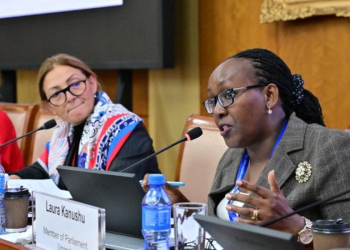
The Inspectorate of Government has cautioned against violations of the law during anti-corruption operations, warning that arrests and the public exposure of suspects must respect the constitutional presumption of innocence and the right to a fair hearing.
The Inspector General of Government, Lady Justice Aisha Naluzze Batala, made the remarks on Monday while presenting the Inspectorate’s biannual performance report to Speaker of Parliament Jacob Marksons Oboth-Oboth.
Naluzze welcomed efforts by Local Government Minister Balaam Barugahara to fight corruption but emphasised that anti-corruption operations must comply with the law and follow established procedures.

The minister has in recent months toured districts, markets, health facilities, and local government offices to inspect ongoing projects and address operational gaps on the spot. His approach often bypasses slow bureaucratic chains to immediately order arrests, suspensions, and interdictions of local officials and service providers linked to extortion and poor service delivery.
But Naluzze warns that efforts to combat corruption should not undermine the rights of suspects or bypass the legal processes required to bring offenders to justice.
Naluzze was responding to concerns raised by the Leader of the Opposition, Joel Ssenyonyi, who questioned whether the Inspectorate was adequately coordinating with other anti-corruption agencies to ensure that arrests made during investigations translated into successful prosecutions.
Ssenyonyi cited the State House Anti-Corruption Unit, the State House Investors Protection Unit and other institutions mandated to fight corruption, questioning why the vice remained widespread despite the number of agencies involved in combating it.
Ssenyonyi also questioned what he described as disparities in the treatment of public officials accused of financial misconduct. He observed that lower-ranking civil servants were sometimes arrested over relatively small sums of money, while cases involving billions of shillings appeared to attract less visible enforcement action.
He insisted that all public funds must be accounted for, regardless of the amounts involved, and challenged the Inspectorate to demonstrate that senior and powerful officials were equally subject to investigation and prosecution.
In response, Naluzze said the Inspectorate coordinates with other anti-corruption institutions through an inter-agency forum that brings together organisations involved in investigations and public accountability.
She explained that the arrangement helps prevent duplication of investigations, minimise the wastage of public resources and avoid conflicting findings when different agencies investigate the same cases.
Naluzze added that the Inspectorate can review investigation reports prepared by other agencies and seek clarification where necessary. It also provides technical support to institutions that require assistance.
She rejected suggestions that certain individuals were beyond the reach of the law, saying the Inspectorate was committed to investigating anyone against whom sufficient evidence of wrongdoing had been established.
The presentation also highlighted concerns over delays in rewarding whistleblowers who provide information that helps expose corruption and recover public funds.
Speaker Oboth-Oboth said whistleblowers played a critical role in identifying corruption and facilitating the recovery of public resources. He argued that the Inspectorate needed an appropriate funding mechanism to ensure that those who provide valuable information receive their legally prescribed rewards.
He urged the institution to consider proposing reforms, including a dedicated budget allocation for whistleblower payments.
Naluzze acknowledged the challenge, explaining that the existing legal framework provides for a reward equivalent to five per cent of the funds actually recovered. She said this arrangement creates difficulties in cases where information provided by whistleblowers helps prevent the loss of public funds but does not result in an actual recovery, leaving the informants without a basis for receiving the statutory reward.
The Inspector General also urged whistleblowers to follow legally prescribed procedures when reporting corruption, cautioning against disclosing information through the media without first using the appropriate reporting channels-URN. Give us feedback on this story through our email: kamwokyatimes@gmail.com