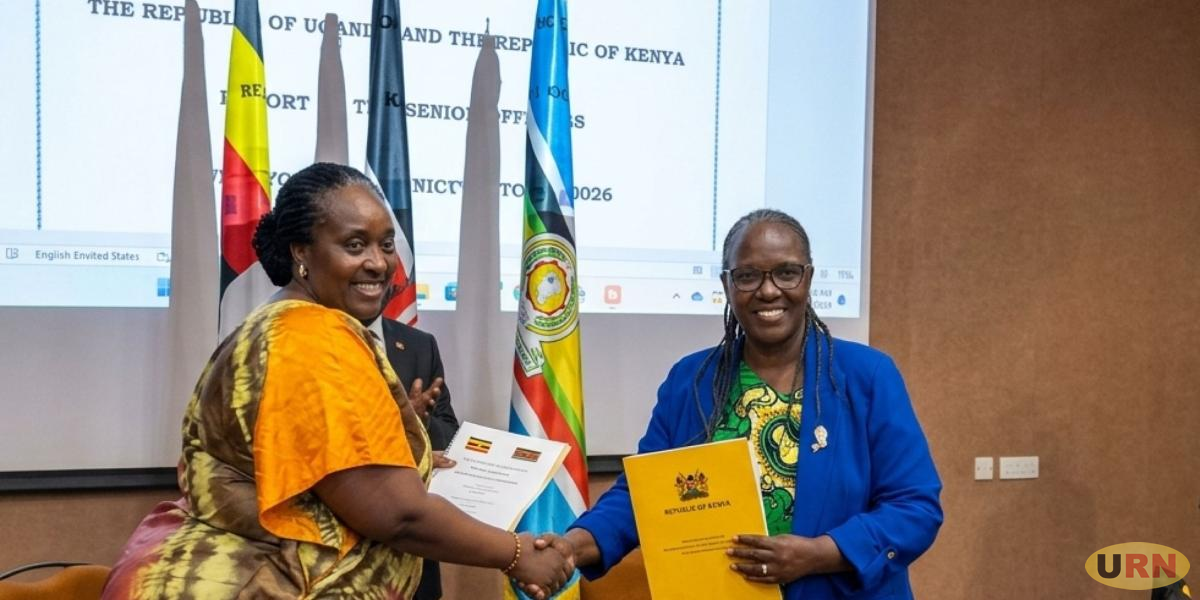
Uganda and Kenya have agreed to remove remaining barriers that restrict the free movement of goods between the two countries, reaffirming their commitment to the East African Community Common Market as officials concluded a joint meeting in Kampala on Monday.
The discussions, led on the Ugandan side by Minister of State for Trade, Industry and Cooperatives Gen. Wilson Mbasu Mbadi, focused primarily on improving market access for Ugandan products in Kenya. The Kampala meeting followed an earlier engagement in August 2026 between Kenyan President William Ruto and Uganda’s trade leadership, at which both sides committed to resolving outstanding trade frictions.
Under the Protocol on the Establishment of the East African Community Common Market, partner states are required to eliminate non-tariff barriers and treat goods originating from other EAC countries as intra-community transfers rather than imports subject to restrictive measures.

Uganda has long complained that Kenyan authorities have on several occasions obstructed Ugandan goods, while Kenyan products continue to enjoy relatively open access to the Ugandan market.
Gen. Mbadi stressed that Uganda is not seeking to reduce or artificially balance trade volumes but to secure fair and predictable conditions.
“We are simply saying provide an environment that allows fair trade competitiveness. Uganda just wants more trade with Kenya. We also want more Ugandan products in the Kenyan market, just like you have access on the Ugandan market,” he said.
“Our concern is therefore not trade itself, but the structure and conditions under which that trade is taking place. A sustainable trading relationship cannot be based on a situation where goods and services predominantly flow in one direction, while Ugandan products face barriers to entering the Kenyan market.”
He warned that persistent imbalance would inevitably create pressure within the bilateral trading relationship.
Uganda’s Permanent Secretary in the Ministry of Trade, Industry and Cooperatives, Lynette B. Bagonza, told URN the meeting that was conducted in Speke Munyonyo aimed to end mistrust and restore smoother trade relations.
“Now that we are under the East African Common Market, we are supposed to be treating all our products as transfers from country to country because we are all in one regional bloc. However, at times you find that different states put in place some kind of measures to protect those businesses that are within those borders,” she said.
“One of the purposes of this meeting was to make sure that we agree that as our products are treated as transfers from nation to nation, we should not have any barriers. And those barriers were resolved that we should by end of June 2026, most of them have actually been dealt with. Others are still in the process.”
She noted that some remaining issues require amendments to national laws, processes that take time and can lead to recurring barriers.
Meanwhile, Kenya’s Principal Secretary in the State Department for Trade, Regina Ombam, affirmed Nairobi’s commitment to implementing agreed measures, including the operationalisation of One-Stop Border Posts and the elimination of discriminatory taxes and levies.
“I wish to state Kenya’s commitment to implementation of these aforementioned issues, because we look at the issue of cross-border trade as the new frontier that will actually help us grow in terms of the economies of our African continent,” Ombam said.
“These resolutions will not happen by chance. We must have constant engagement. We must continue with a spirit of partnership. And we must show commitment to mutual respect and build trust in our relationship.”
The East African Community Customs Union and Common Market Protocol obligate partner states to remove existing non-tariff barriers and refrain from introducing new ones. In practice, however, administrative restrictions, standards-related delays, discriminatory levies and border inefficiencies have repeatedly disrupted trade flows along key corridors such as Malaba and Busia.
Both delegations described the latest round of talks as constructive and expressed confidence that sustained engagement would strengthen regional value chains, increase private-sector participation and deepen economic integration.
Implementation of the remaining commitments, particularly those requiring legislative changes, will determine whether the latest agreement translates into freer and more balanced trade between East Africa’s two largest economies.
Formal two-way goods trade between Uganda and Kenya runs into the range of US$1.5–1.8 billion annually, making it one of the most significant commercial relationships within the East African Community.
Uganda exported roughly US$590 million worth of goods to Kenya in 2024, led by dairy products, iron and steel, coffee and tea, ceramics, wood products, animal feed, maize and other cereals, vegetables and sugar.
Kenya, meanwhile, ships significantly more into Uganda, recent figures put its exports between US$900 million and US$1.25 billion, dominated by petroleum products, cement and construction materials, iron and steel, edible oils, plastics, soaps, pharmaceuticals, vehicles and a wide range of manufactured consumer goods-URN. Give us feedback on this story through our email: kamwokyatimes@gmail.com