Kitgum District Chief Administrative Officer (CAO) Habib Abubakar has warned head teachers of government-aided schools against imposing unauthorized fees and levies on parents and learners, threatening disciplinary action against those who defy the directive.
The warning follows a recent directive by Minister of State for Local Government Balaam Barugahara against the compulsory collection of Parents Teachers Association (PTA) fees and other unauthorized charges in government-aided schools.

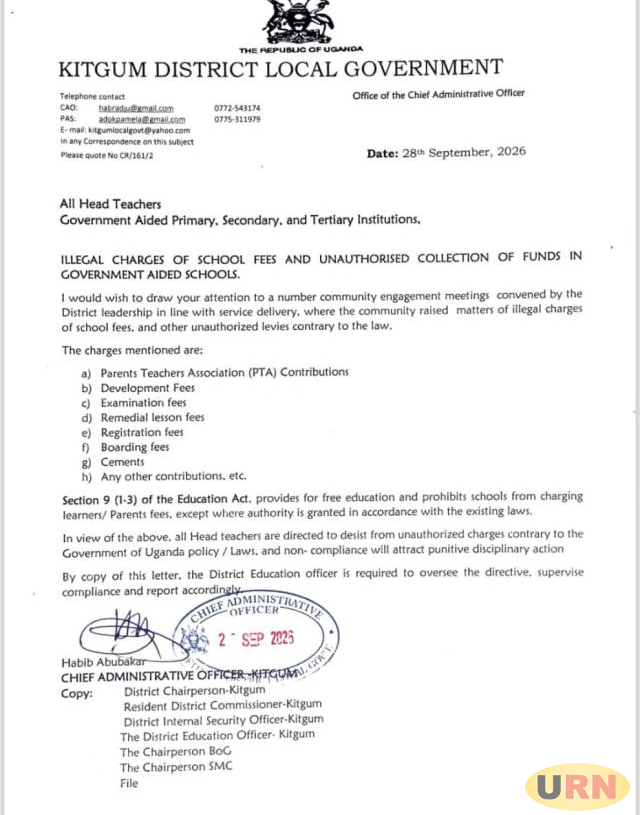
In a circular dated September 28, 2026, Abubakar directed head teachers of government-aided primary and secondary schools and tertiary institutions in the district to immediately stop collecting fees and contributions that are not sanctioned by government.
Abubakar said the directive followed concerns raised by members of the public during community engagements over unauthorized charges imposed on parents and learners. Prohibited charges include PTA contributions, development fees, examination fees, remedial lesson fees, registration fees, boarding fees and demands for building materials such as cement.
The CAO also warned school administrators against introducing any other charges that are not authorized by law. Abubakar cited Section 9 of the Education Act, which provides for free education in government-aided institutions and restricts schools from imposing fees on learners or parents except as provided for under the law.
“All Head teachers are directed to desist from unauthorized charges contrary to the Government of Uganda policy/Laws, and non-compliance will attract punitive disciplinary action,” Abubakar said.
The District Education Officer has been tasked with monitoring compliance and reporting to the district authorities.
The directive was also copied to the District Chairperson, Resident District Commissioner, District Internal Security Officer, and chairpersons of school boards Management Committees for oversight.
The directive has received mixed reactions from parents, with some welcoming it as relief from the financial burden of repeated school demands, while others fear schools could struggle to meet basic operational needs without adequate government funding.
Joseph Ogweng Okellowange, a former parliamentary candidate for Chua West County, said the government should distinguish between compulsory school charges and voluntary contributions.
He cited Section 10 of the Education Act, 2008, which prohibits compulsory charges in UPE and UPPET institutions, while allowing voluntary contributions from parents and well-wishers for emergencies or urgent school needs. The Act also prohibits schools from excluding a child because a parent has failed to make a voluntary contribution.
“The debate should not be reduced to ‘parents must not pay’; the bigger question is whether Government is adequately financing UPE and USE,” Ogweng said, but adding that while compulsory charges should be prohibited, government should provide schools with adequate funding to meet their operational needs.
“Free education must not mean unfunded education,” he said, adding that schools still need learning materials, sanitation, water, electricity, maintenance, assessment and security, among other. He said if government prohibits parental contributions, it should take full responsibility for financing the needs.
For some low-income families, however, the directive has been welcomed as a reprieve from what they describe as repeated financial demands from schools.
Geoffrey Okeny, a Kitgum Municipality parent parent, said some families have struggled to meet PTA and development-related demands in addition to other household expenses.
“Parents have been overburdened by unending demands for money under the guise of PTA and development funds,” he said. “In many schools, children were routinely turned away or miss exams simply because parents could not afford extra levies beyond the government’s free education policy.”
He welcomed the directive, describing it as timely and needed to protect parents from extra charges. However, Santa Adongpiny, a parent with two children in a government-aided primary school, said a complete ban on parental contributions could affect schools if government does not increase funding.
“While free education sounds good, the reality is different. PTA contributions are what some schools use to pay community-hired teachers, buy chalk and maintain basic sanitation,” Adongpiny said.
She warned that removing such support without increasing government capitation grants could leave schools struggling to meet basic needs. “Stripping schools of these funds without increasing government capitation will force head teachers to lay off staff, leaving our children without teachers in classrooms,” she said.
The debate comes amid concerns over poor performance in recent primary school mock examinations in Kitgum, raising questions about the adequacy of resources available to schools. In the primary school mock results, candidates in 10 schools all obtained Division U, while all candidates in another seven schools obtained Division Four-URN. Give us feedback on this story through our email: kamwokyatimes@gmail.com