Accounting officers have been directed to incorporate National Resistance Movement (NRM) manifesto commitments into government budgets, work plans and other planning instruments to ensure they are translated into funded and measurable programmes.
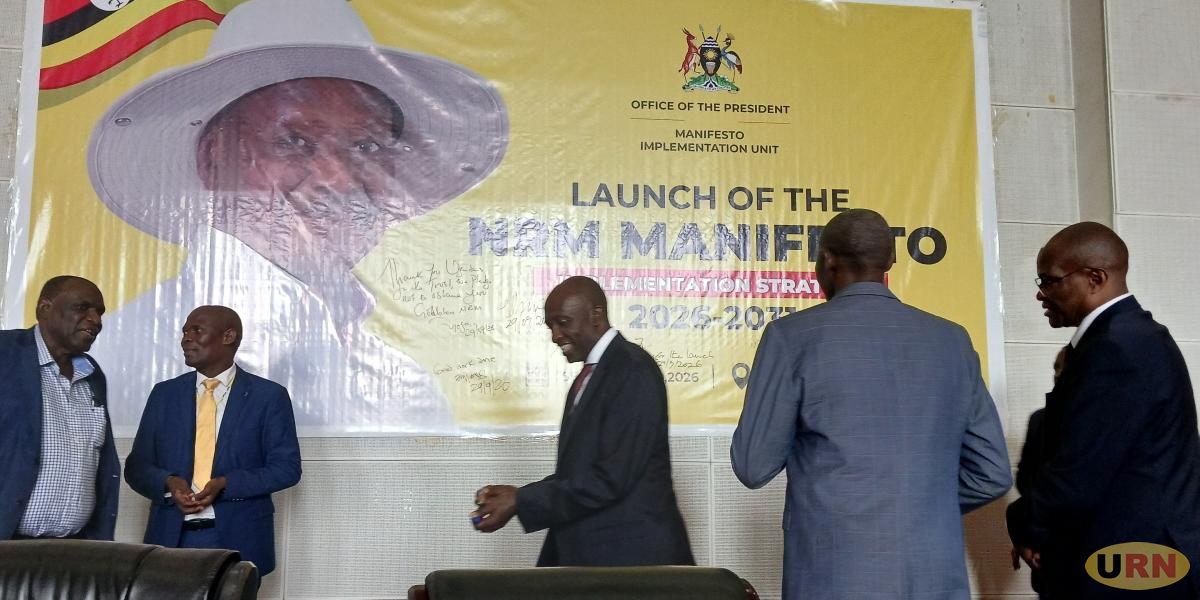
The directive was issued during the launch of the Manifesto Implementation Strategy on Tuesday, where government officials said manifesto commitments should no longer be treated as campaign promises once an administration assumes office. Willis Bashasha, the Director of the Manifesto Implementation Unit, said accounting officers are required to budget for and sequence manifesto commitments in line with available financial resources.
He said the manifesto becomes a blueprint for service delivery after an election and creates an accountability relationship between government and citizens. “The manifesto, when we cross over to government, becomes a blueprint for service delivery because the government is accountable,” Bashasha said. He said the commitments should be implemented through existing government votes, budgets and accounting officers rather than through a separate implementation system.

The new framework is intended to guide the implementation of 293 commitments contained in the 2026–2031 NRM manifesto across five pillars over the five years. Bashasha said the framework aligns the manifesto commitments with the 18 programmes under the Fourth National Development Plan (NDP IV), including their respective programme and financing structures.
He said the alignment will enable each government entity to identify commitments falling under its vote and incorporate them into its planning and budgeting processes. “Anything that is outside of the planning framework now cannot be funded or find a budget,” Bashasha said.
He urged accounting officers to extract commitments assigned to their respective votes, reconcile them with their work plans and identify commitments that have not yet been incorporated into their plans. Bashasha said the Budget Framework Papers, which are due on November 15, will be scrutinised to establish whether manifesto commitments have been incorporated into the respective budgets.
He said discussions had also been held with the Parliamentary Budget Office and other oversight structures on how the results framework would be used to assess implementation. Although the framework provides a five-year roadmap, Bashasha said implementation and review will be undertaken annually through the normal government budget cycle.
He also said every manifesto commitment must have an assigned owner to ensure clear responsibility for implementation and accountability. Permanent Secretaries, accounting officers and designated manifesto focal persons will therefore be expected to ensure that commitments are translated from the political manifesto into funded programmes, measurable outputs and verifiable results.
Hajji Yunusu Kakande, Secretary in the Office of the President, said the new strategy will track the 293 manifesto commitments using 596 indicators aligned with indicators under the National Development Plan. He said the alignment is intended to integrate implementation of the NRM manifesto into Uganda’s broader national development agenda.
Kakande said the new strategy also seeks to shift government monitoring away from simply reporting activities and expenditure towards measuring tangible results. Government agencies will be required to provide physical and empirical evidence of completed projects and services instead of only reporting how much money has been spent.
Monitoring will also assess outcomes such as the number of jobs created and the number of households that have moved from subsistence into the money economy. Kakande said youth unemployment, skills development and expansion of the service sector will receive increased attention alongside agriculture. Government will also introduce an annual manifesto circular outlining priorities that implementing agencies are expected to deliver during each financial year.
The circular will accompany the budgeting process and is expected to guide the incorporation of manifesto commitments, indicators and targets into government planning and budgets for subsequent financial years. Kakande urged government institutions to use the budgeting process to ensure that manifesto commitments are adequately financed.
The state minister for Kampala and Metropolitan Affairs, Kabuye Kyofatogabye, who represented the Minister of the Presidency Milly Babalanda, warned government officials that the period of adjustment was over and that they must now demonstrate tangible results in implementing national programmes. Kyofatogabye urged officials to move from planning to implementation and ensure that resources allocated to national projects deliver value to citizens.
He also called for the removal of bureaucratic delays, saying government programmes must be implemented efficiently and produce measurable results. Monitoring and oversight teams, including Resident City Commissioners and Resident District Commissioners, were directed to strengthen supervision of government projects.
The strategy comes after the government reported that 87 percent of commitments under the previous NRM manifesto had been implemented by the end of its implementation period. Of the commitments assessed, 54 percent had been achieved, while 33 percent were still ongoing, with the remaining commitments yet to be implemented-URN. Give us feedback on this story through our email: kamwokyatimes@gmail.com