The National Female Representative for Persons with Disabilities in Parliament, Laura Kanushu, has called on the Ministry of Health to make disability inclusion a central part of its planning and budgeting, saying people with disabilities should not have to repeatedly plead for access to basic healthcare services.
Kanushu said disability should be treated as a cross-cutting issue across government rather than a responsibility left mainly to the Ministry of Gender, Labour and Social Development.
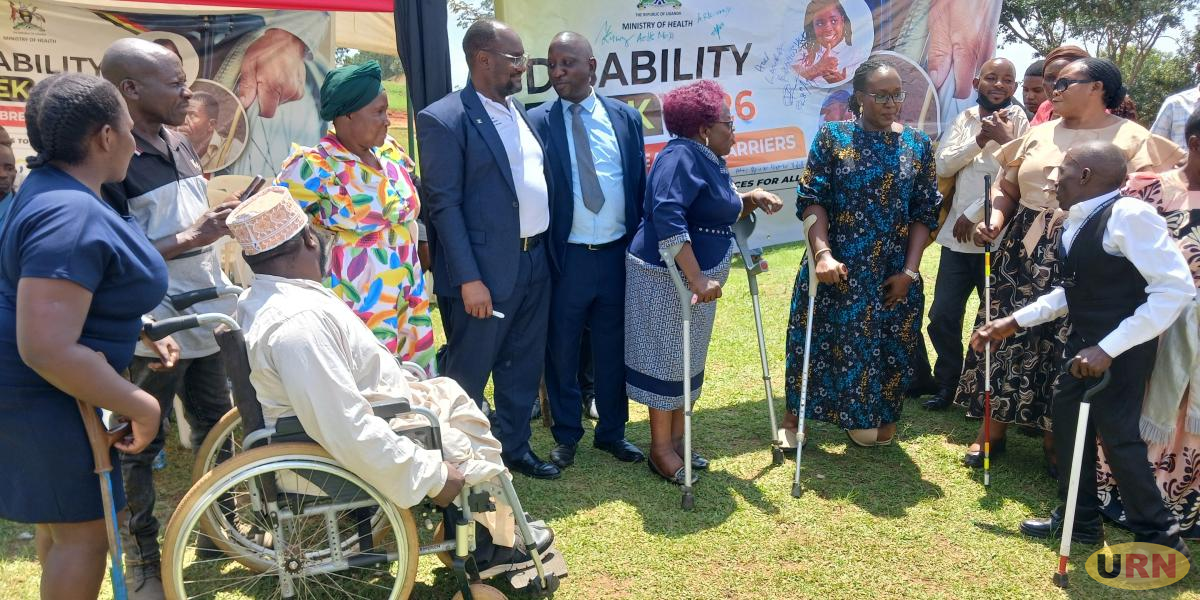
She was speaking at Wakiso Secondary School of the Deaf on Monday during the launch of Disability Inclusion Week, an initiative organised by the Ministry of Health to raise awareness about the health needs and rights of persons with disabilities.

Kanushu said many people with disabilities continue to face physical, communication and financial barriers when seeking healthcare, despite government efforts to promote their rights.
She said these barriers include inaccessible health facilities, inadequate assistive devices, limited disability-sensitive services and a shortage of sign-language interpreters.“Disability inclusion must be reflected in planning and resource allocation. If budgets are inclusive, services become accessible, and no one is left behind,” Kanushu said.
Kanushu, who is herself a person with a disability, said her experience had exposed her to some of the difficulties faced by persons with disabilities when accessing healthcare.
She questioned why newly constructed health facilities should continue to rely on stairs when ramps can accommodate persons with disabilities as well as older people and pregnant women.
She also cited hospital equipment, including beds that may be difficult for women with physical disabilities to access.
Kanushu said assistive devices such as wheelchairs, crutches and white canes should not be viewed only as medical supplies for sick people because many persons with disabilities depend on them to work, study and participate independently in society.
She called for a review of how such devices are distributed and questioned whether their provision should remain exclusively under the Ministry of Health.
Kanushu also urged the government to strengthen the availability of sign-language interpreters in public institutions, particularly health facilities and district structures.
She proposed that sign language be incorporated into the education curriculum so that more Ugandans acquire basic communication skills that would enable them to interact with deaf people.
She said district-level employment of sign-language interpreters could also help bridge communication gaps by ensuring that interpreters are available to support deaf people in hospitals and other public institutions.
Anna Nakitende, a deaf student studying Physics, Economics and Mathematics and Information and Communication Technology at Wakiso Secondary School of the Deaf, said communication remains one of the biggest barriers faced by deaf people seeking medical care.
Nakitende said few health workers can communicate in sign language, leaving many deaf patients dependent on interpreters or other forms of communication that may not adequately convey their medical needs.
She called for the recruitment and deployment of sign-language interpreters in health facilities and urged health workers to acquire basic sign-language skills so that deaf patients can communicate directly with them.
Nakitende said direct communication was particularly important when patients were discussing sensitive or confidential medical information.
She also raised concerns about health information that is disseminated to the public, saying much of it remains inaccessible to deaf people, particularly those with limited access to formal education or who do not understand English.
She called for health information to be provided in sign language and other accessible formats.
Nakitende warned that communication difficulties between deaf patients and health workers could result in misunderstandings and wrong diagnoses, putting patients’ lives at risk.
Esau Muhumya, a health worker at Wakiso Health Centre IV who coordinates tuberculosis activities at district level, represented the district health officer at the event.
Muhumya said health facilities should strengthen communication with deaf clients through sign language, interpreters, written communication, visual materials and other reasonable accommodations.
He recalled an experience involving a pregnant deaf woman who struggled to access healthcare because no one at the facility could communicate with her.“Nobody at the facility could help this lady. I was able to communicate with her using simple signs,” Muhumya said.
He said his ability to communicate with the woman enabled her to access further medical investigations, including a CT scan and ultrasound at Mulago.
Muhumya said the experience demonstrated how communication barriers can directly affect access to healthcare.
He stressed that disability inclusion should not be left to one institution or sector, saying the health sector has a responsibility to provide accessible and respectful services while the education sector should create inclusive learning environments.
He also urged parents and caregivers to support children with disabilities and called on communities to challenge stigma, discrimination and harmful attitudes towards people with disabilities.
Kanushu said Members of Parliament representing persons with disabilities would support budget proposals that intentionally address their needs.She urged the Ministry of Health to involve Parliament early in the budgeting process and prioritise disability-related programmes when preparing its plans.
She said investment in disability inclusion is not only a human rights obligation but can also improve health outcomes and enable persons with disabilities to participate more fully in national development.
The Ministry of Health says disability inclusion is part of efforts to achieve universal health coverage and ensure that Ugandans can access quality healthcare regardless of ability.
According to the final 2024 National Population and Housing Census report, Uganda has about 5.5 million persons with disabilities, representing approximately 13.2 percent of the population. Disability Inclusion Week is intended to draw attention to the needs of people with physical, sensory, intellectual, and psychosocial disabilities and promote health services that are accessible to them-URN. Give us feedback on this story through our email: kamwokyatimes@gmail.com