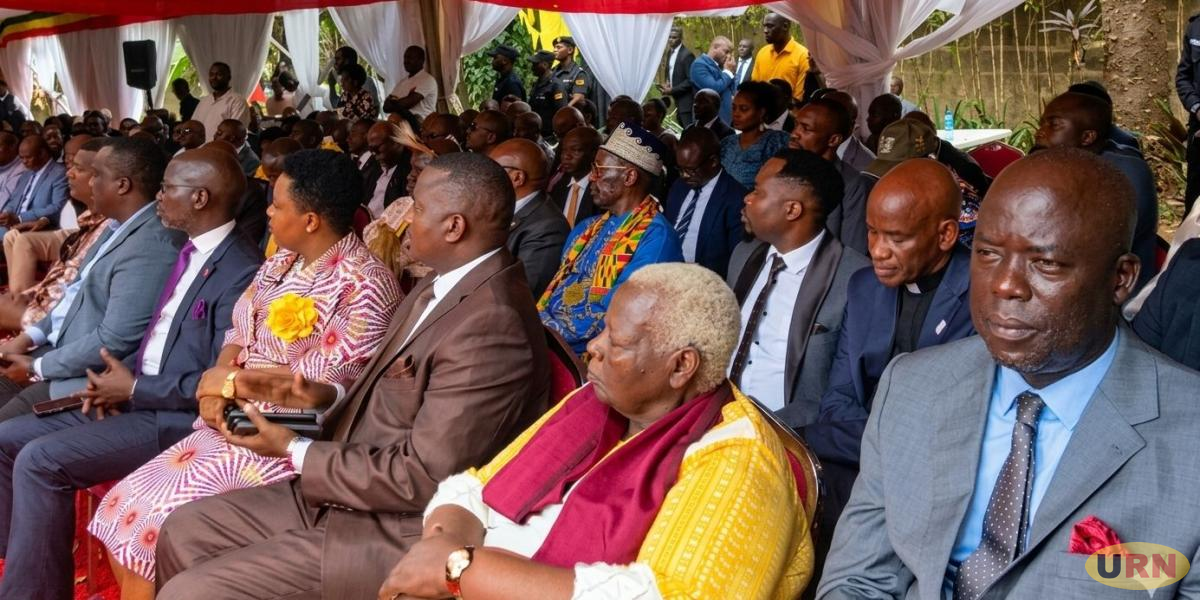
Former Aruu MP Samuel Odonga Otto attended the launch of the Patriotic League of Uganda (PLU) website and related mobilisation tools, triggering debate about his intention given that he has been one of the critics of the current administration.
Otto defended himself on Monday, saying it was a deliberate act of political realism rather than casual curiosity.
“My decision to attend the PLU launch was well thought and not casual,” Otto wrote on X.

Some have suggested that Otto’s appearance at the launch carries significance beyond his physical presence at the event.
His own explanation suggests that he is assessing political realities rather than making an impulsive decision.
“Realism and idealism in political science are different,” he wrote, signalling that his participation should be understood within a broader political calculation.
PLU is an organisation chaired by Gen. Muhoozi Kainerugaba, Chief of Defence Forces and son of President Yoweri Museveni
Otto’s attendance comes amid an aggressive expansion of PLU activities.
The same day saw the unveiling of a digital platform for membership registration and presidential endorsements, the distribution of Patriotic Officers’ identification cards, and parallel efforts to roll out village registers targeting roughly 72,214 villages in Uganda.
Michael Mawanda, PLU’s Director of Mobilization framed the tools as instruments for grassroots mobilisation and a signature drive aiming for millions of endorsements in support of Gen. Muhoozi’s declared interest in the presidency in 2031.
Deputy Speaker of Parliament Thomas Tayebwa, who attended as chief guest and holds a role as PLU special envoy, described the organisation as a civic platform working closely with the ruling National Resistance Movement (NRM).
“The NRM remains our political home, while PLU provides a civic platform to organise citizens, especially young people, around patriotism, national service, and the defence of Uganda’s gains,” he said.
Tayebwa characterised the endorsement drive as a lawful expression of confidence in a leader who has dedicated his life to the country’s defence and development.
PLU presents itself as a patriotic civic movement focused on national unity, service, and development. It maintains it is not a political party and operates in alignment with the NRM.
Yet its structure, complete with hierarchical “Patriotic Officer” rankings modelled partly on historical liberation-era systems, and its explicit 2031 presidential mobilisation have fuelled intense debate about its true character.
The organisation’s status sits at the intersection of several key Ugandan laws. The Non-Governmental Organisations Act requires registered organisations to remain non-partisan.
Section 44 and related provisions prohibit NGOs from engaging in fundraising or campaigning to support or oppose any political party or candidate for elective office, or from proposing or registering candidates.
PLU has been described by supporters and some officials as a civic organisation; critics argue its activities cross into partisan territory.
Article 208 of the 1995 Constitution requires the Uganda Peoples’ Defence Forces to remain non-partisan, national in character, and subordinate to civilian authority.
Section 99 of the UPDF Act, 2005, restricts serving military personnel from engaging in partisan politics without first resigning or retiring from the forces.
Gen. Muhoozi continues to serve as Chief of Defence Forces while chairing PLU and publicly signalling long-term political ambitions.
The Political Parties and Organisations Act regulates the formation and conduct of political organisations, defining them broadly as associations whose objects include influencing the political process.
Leader of the Opposition in Parliament Joel Ssenyonyu questioned whether PLU functions in practice as an unregistered political organisation operating under the protective umbrella of the ruling establishment and military hierarchy.
Otto himself has previously spoken critically of the group. In television appearances, he described discussing PLU as “a very risky business” and characterised its leader as a “very dangerous man,” while raising questions about the organisation’s legal status and the broader implications of military influence in civilian politics.
His decision to attend the launch and leave open the possibility of deeper involvement therefore represents a notable shift.
Otto’s career offers context for the calculation. Elected to Parliament in 2001 at a young age, he represented Aruu County for two decades, served on key committees, and built a reputation as a sharp, often confrontational critic of government policy.
After losing his seat in 2021 and the recently concluded 2026 Aruu South Constituency bid, and navigating shifts between parties and independent status, he has remained a visible public figure and practising lawyer-URN. Give us feedback on this story through our email: kamwokyatimes@gmail.com