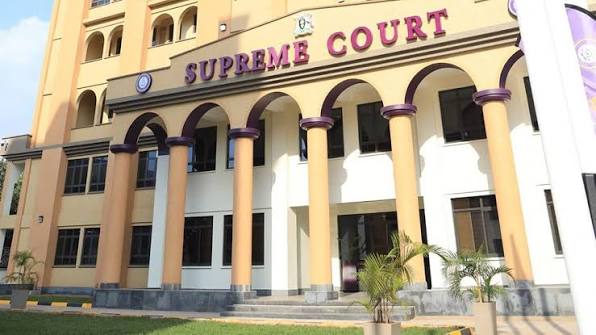
The Supreme Court has rejected the Attorney General’s attempt to reopen a case in which the government was ordered to pay fifty billion shillings to Henley Properties Development Ltd after the land registry issued competing titles over the same property.
In a unanimous decision, the five-member panel held that allowing the government to relitigate the case would undermine the principle of finality of litigation and effectively turn the Supreme Court into an appellate court over its own decisions.
The court said its review jurisdiction is exceptional and cannot be used by a party to rehear evidence, revisit factual findings or challenge the merits of a decision simply because it disagrees with the outcome.

Justice Lilian Tibatemwa-Ekirikubinza, in one of the rulings, said granting the government’s application would amount to asking the Supreme Court to “sit in appeal of its own decision.”
She said this would violate the principle that litigation must eventually come to an end once a dispute has been determined by the highest court in the country.
The dispute arose from a land transaction involving about 305.86 acres in Kasenso-Namasaga, Kyaggwe, East Buganda, which Henley Properties Development Ltd identified in 2011 for development of a commercial business park.
The land was registered in the name of Nantume Flomera Nakalema, administrator of the estate of the late Samuel Kiwanuka Katiginya.
Before purchasing the property, Henley Properties conducted three official searches at the Mukono District Land Office between October 2011 and February 2012.
The searches, certified by the Registrar of Titles, confirmed Nantume as the registered proprietor and showed no encumbrances on the title.
The company subsequently entered into a sale agreement with Nantume on November 12, 2011, for six billion shillings. It paid the purchase price, paid the required stamp duty and registered the transfer, becoming the registered proprietor of the land.
The dispute emerged when the Commissioner for Land Registration notified the company in 2016 of the intention to cancel its title.
An inspection of registry records had revealed that the land covered by Henley Properties’ title overlapped with an 882.39-acre freehold title registered in the name of Sugar Corporation of Uganda Limited since 2007, under a historical title dating back to 1947.
Henley Properties sued the Registrar of Titles, arguing that it had acquired the land after conducting official searches and relying on the records maintained by the land registry.
The High Court ruled in favour of the company and awarded fifty billion shillings in compensation, in addition to costs.
The government appealed the decision to the Court of Appeal and later to the Supreme Court, but lost both appeals, with the two appellate courts upholding the High Court’s decision.
The Attorney General again returned to the Supreme Court seeking a review of its decision.
The Supreme Court entertained the matter but went ahead to dismiss it. The judgment means that the government has to pay Henley Properties Development Ltd the money as directed by the High Court, with costs.
In the lead judgment, Justice Christopher Madrama Izama said the review application amounted to an attempt by the government to open up (relitigate ) a matter that had already been conclusively determined.
He said the Supreme Court’s power to review its own decisions is a narrowly defined safeguard and cannot be used to correct alleged errors of law or reconsider the substance of a judgment.
Under Rule 35 of the Supreme Court Rules, the court said, the review mechanism is principally limited to correcting arithmetical or clerical errors and giving effect to the court’s original intention.
Justice Madrama said the court should adopt a restrictive approach to exceptional review applications to protect the finality of judicial decisions and public confidence in the administration of justice.
He also proposed stronger safeguards against abuse of the review process, including mandatory filing timelines, clearer grounds for exceptional review and personal financial consequences for advocates who file frivolous applications.
The court acknowledged that the Shs50 billion compensation represents a significant cost to the taxpayer.
However, Justice Madrama said allowing the land registry to issue competing titles and subsequently escape liability would expose taxpayers to an even greater risk.
He said the government’s financial liability resulted from omissions within its own land registration system.
The court further held that if the government believed the vendors had sold land they did not own, it should have pursued them through third-party proceedings during the original trial rather than attempting to shift that liability onto Henley Properties through a review application.
The judges also rejected the argument that the company should be forced to pursue the vendors after relying on official land registry searches that had confirmed its title.
The Supreme Court said the land registry cannot issue a title, allow a transaction to proceed on the strength of official searches and later seek to cancel the title after property and commercial rights have already been acquired.
The judgment was delivered by a panel comprising Justices Christopher Madrama Izama, Lilian Tibatemwa-Ekirikubinza, Stephen Musota, Mike Chibita and Mercy Night Tuhaise-URN. Give us feedback on this story through our email: kamwokyatimes@gmail.com