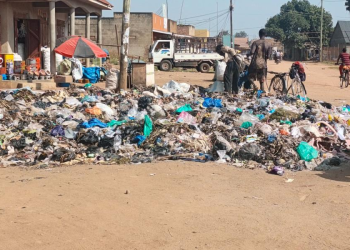
For a farmer in rural Uganda, South Sudan or Ethiopia, El Niño is unlikely to be understood as a scientific term. It is more likely to be felt when a heavy downpour washes away a feeder road, destroys a crop planted with borrowed money or pushes food prices higher.
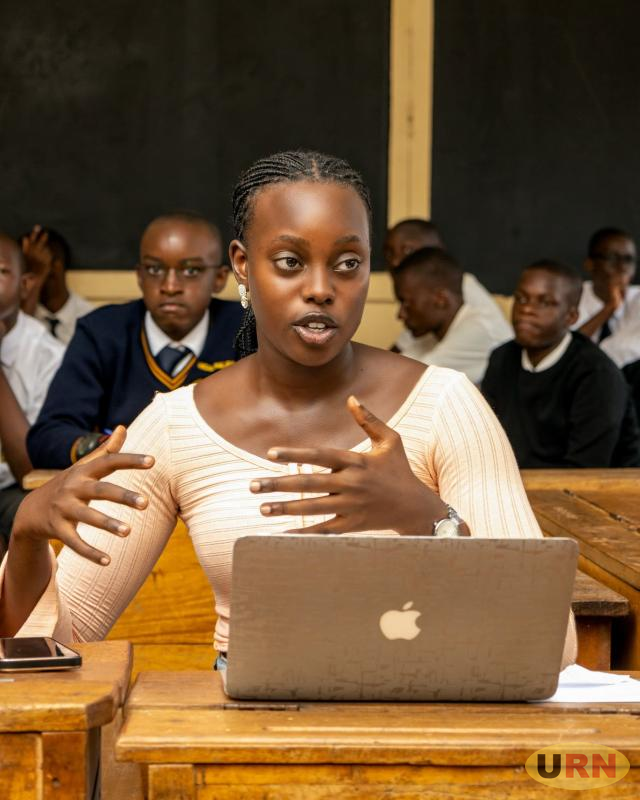
That was the message from young Ugandan climate activist Ayebare Denise as climate scientists, governments, development partners and young Africans gathered in Kigali, Rwanda, for the 74th Greater Horn of Africa Climate Outlook Forum, GHACOF 74.
The forum, taking place in Kigali Rwanda, is convened by the IGAD Climate Prediction and Applications Centre (ICPAC) under the theme: “Harnessing Climate Services for Early Action and Resilience in the Greater Horn of Africa Region in the Face of a Strong El Niño.”

Ayebare attempted to convey the realities as a young farmer understands them, just as a young person in Uganda or elsewhere on the continent does. She also called for greater investment in young Africans who are developing solutions around climate data, artificial intelligence and agriculture.
“The question before us today, ladies and gentlemen, is not simply whether we can produce a better forecast. The question is what moves because we know,” she said.
Ayebare urged participants to look beyond the scientific language of climate prediction and consider what happens after a forecast is issued. “El Niño, in my communities, it is not felt as a scientific word. Just like all the data that has been presented, it reaches us in a feeder road that is washed away when the farmer cannot take their produce to the market.”
Ayebare warned that the impact of climate shocks does not end in the garden. She explained that a farmer who borrows money to plant can lose an entire season when excessive rainfall destroys crops, or when expected rains fail to arrive. The financial institution, she argued, is not necessarily concerned about the climate forecast but wants to know whether the borrower will repay.
“The bank, the SACO, the institution, doesn’t want to understand El Niño with you. It doesn’t want to cancel the repayment debt with you. What it wants to understand is: are you going to pay?” That, Ayebare said, is how an environmental crisis can quickly become an economic crisis.
“So what started as a climate crisis suddenly becomes a debt problem. Even worse, an economic problem in the lives of these young people. The harvests fail, the household incomes fall, but then you also find that even in most desperate situations, families begin making decisions they couldn’t have made in ordinary seasons.” She explained.
The consequences can spread even further into households and communities. She cited reports of severe drought in the Horn of Africa and the pressure placed on vulnerable families, including cases where young girls were subjected to child marriage. She illustrated why climate resilience cannot be separated from questions of poverty, household income, food security, health and dignity.
“Climate shocks can enter almost every part of a person’s life. If it starts with the weather, it ends up in our farm, it enters our bank accounts, it even enters the dignity that we would want to survive,” said Ayebare. She went on to question the relevance of early warning systems, arguing that it is not simply whether scientists can predict extreme weather.
“Early warning systems, early action, and resilience must increasingly become regional too. Because if a young person or even a young farmer, for example, in Uganda exists, they don’t exist in air-conditioned rooms like we are discussing this here today. When it is hot at night, their option is A, that open the window. When they open the window, thieves either break in or mosquitoes enter, or sometimes even both. So, what started as a climate crisis becomes a health crisis,” she explained.
She argued that warning systems should be judged by what they enable people to do, not merely by how accurate the forecast is. “It is not enough to know that suffering is coming. The point is to make sure that because we knew, somebody suffers less.”
Ayebare pointed to the growing involvement of young Africans in technologies such as artificial intelligence, geographic information systems, the Internet of Things and remote sensing.
She argued that young people should help translate climate information into forms that farmers and communities can understand and use. “Who has to translate this into local languages? Who has to ensure that we do not lose this? That has to be us, young Africans?” she asked.
She argued that youth participation should not simply mean being invited to conferences or being consulted on projects, but they should have a stake in the businesses and economic opportunities emerging from climate information and agriculture.
“There is an entire economy between the forecast and the farm, and there is another entire economy between the farm and the final consumer. Our generation should be building and owning much of both,” Stated Ayebare.
She challenged governments, regional institutions and development partners to support young entrepreneurs not only with praise, but with actual markets. “Because young people cannot build businesses only on applause.” Ayebare also challenged the perception of agriculture as an occupation of last resort for young Africans.
She referred to a common Ugandan expression, “Sijakulima”, meaning “I am not going to dig,” to illustrate the reluctance among some young people to associate agriculture with opportunity. She suggested that modern agriculture is increasingly connected to science, technology and business.
“Agriculture is climate science. It’s innovation. It’s data. It’s artificial intelligence. It’s processing. It’s branding and trade.” She noted that the real opportunity is not simply producing crops but ensuring that African countries and young Africans capture more of the value generated from those crops.
She pointed to the region’s coffee, tea, flowers and food production as examples. “We cannot spend the next 20 years asking to be included in economies that we should be helping to build. We cannot continue growing the coffee while somebody else owns the coffee economy. We cannot produce the tea while someone owns the tea economy,” she said.
She said a failed season means lost production. For her, even a successful harvest can leave African farmers and economies with limited returns if the crops are exported without sufficient processing and value addition. “Africa cannot afford to lose twice. You know, when the season is bad, we lose the harvest. When the season is good, we also lose that value because processing and all this does not happen.” She spoke-URN. Give us feedback on this story through our email: kamwokyatimes@gmail.com