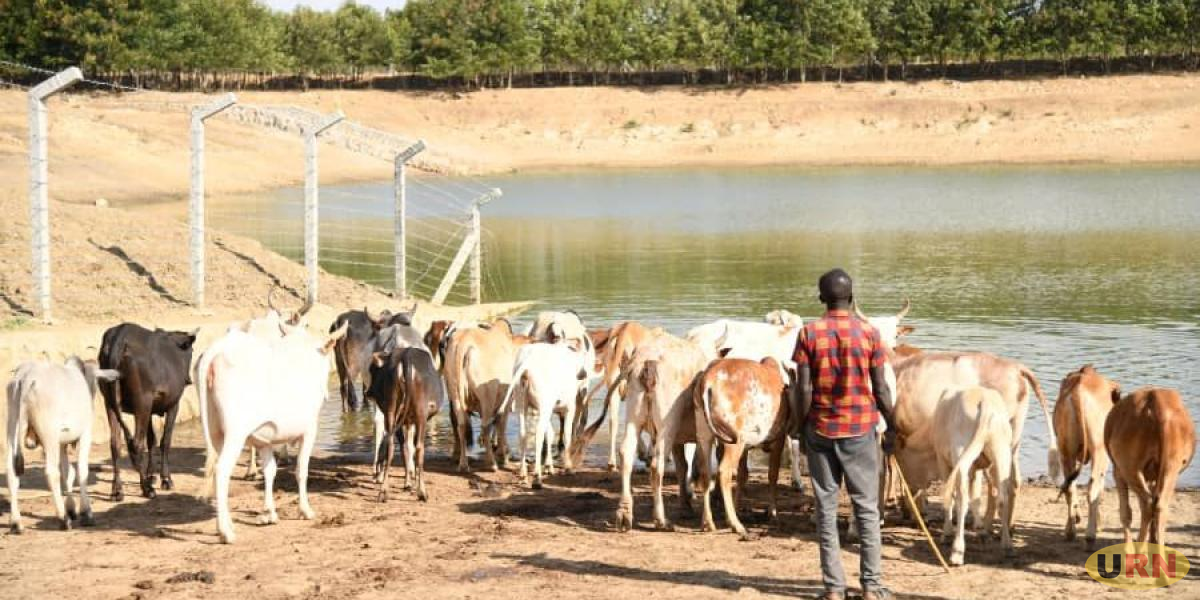
For years, pastoralists in South Amudat spent hours driving their livestock across long distances in search of water, often competing with neighbouring communities during prolonged dry spells. Today, that struggle has eased after the rehabilitation of Akurawoyan Dam, a vital water source that is restoring livelihoods for thousands of pastoralist families in Uganda’s Karamoja sub-region and neighbouring Kenya.
The dam, located in Abongoi Parish in Amudat District, had fallen into disrepair nearly a decade after it was first constructed, forcing communities to rely on distant water sources and boreholes that were often insufficient for both people and livestock. Christine Chemukei, the parish councillor for Abongoi Parish, said the restored dam has transformed life for local herders.
“This dam has relieved us. Without it, during the dry season we walked miles looking for water or depended on boreholes to water our animals, yet the water was never enough. Even domestic water came from the same sources,” Chemukei said. She added that before the rehabilitation, the dam could not contain heavy rains, causing flooding in surrounding areas. The upgraded facility now safely stores more water while excess runoff is channelled into a nearby stream.

“This dam used to be too small to hold enough water. Now it stores much more and lasts well into the dry season,” she said. Although the rehabilitation has reduced water shortages, Chemukei said challenges remain. She cited muddy water when the reservoir fills, the risk of disease transmission as livestock from different areas share the same water source, and continued siltation from a nearby stream.
She appealed for more livestock vaccination campaigns, construction of watering troughs outside the dam to stop animals from entering the reservoir directly, and measures to divert the stream to reduce silt accumulation. The rehabilitation was undertaken under the Pastoralism and Livestock Adaptation for Climate Change in Eastern Africa (PLACE) project implemented by the Food and Agriculture Organization of the United Nations (FAO).
Michael Ade, the FAO officer overseeing the project’s environmental component, said the district requested the rehabilitation because of the dam’s importance to both Ugandan and Kenyan pastoralists. “This particular dam serves Pokot communities from Amudat District and those crossing from West Pokot in Kenya under existing cross-border agreements,” Ade said.
He said the works included desilting the reservoir, fencing the site, constructing a drinking slab and installing an inlet channel. “Its holding capacity has been increased to 20,000 cubic metres, enabling it to support far more than the 2,000 head of cattle it was originally designed to serve,” he said.
Amudat District Veterinary Officer Michael Kaziro said the southern part of the district alone has an estimated 339,000 cattle, about 500,000 goats and nearly 200,000 sheep, all of which depend on water facilities such as Akurawoyan Dam. He noted that demand rises sharply during severe droughts when herders from Kenya cross into Uganda in search of water.
“This water facility has relieved this community of water stress. Beyond livestock, it also supports small-scale irrigation and provides water for domestic use where boreholes have broken down,” Kaziro said. He explained that pastoralist communities on both sides of the Uganda-Kenya border have traditionally shared grazing land and water resources.
“For us, we define the border and say there is a border here. But these people are one. There is nothing like a border for them. They come in, and they go out,” Kaziro said. Local leaders say a water users’ committee will soon be established to manage the dam sustainably. Plans include training communities to keep livestock out of the reservoir, planting grass along the banks to control erosion and eventually installing a pumping system to reduce manual water collection.
Akurawoyan Dam is one of several water facilities rehabilitated under the PLACE programme, which operates across seven drought-prone countries—Uganda, Kenya, Sudan, South Sudan, Ethiopia, Somalia and Tanzania—to strengthen the resilience of pastoralist communities affected by climate change. The programme has also supported livestock vaccination campaigns against contagious bovine pleuropneumonia, contagious caprine pleuropneumonia, Peste des Petits Ruminants (PPR) and foot-and-mouth disease.
According to Ade, nearly 900,000 livestock have so far been vaccinated across the wider Karamoja cluster, with another cross-border vaccination campaign planned before the end of the year to cover animals migrating from Kenya. For pastoralist families in Amudat, the restored Akurawoyan Dam is more than a water source—it is reducing the burden of long journeys, easing competition over scarce resources and helping communities build resilience against increasingly frequent droughts-URN. Give us feedback on this story through our email: kamwokyatimes@gmail.com