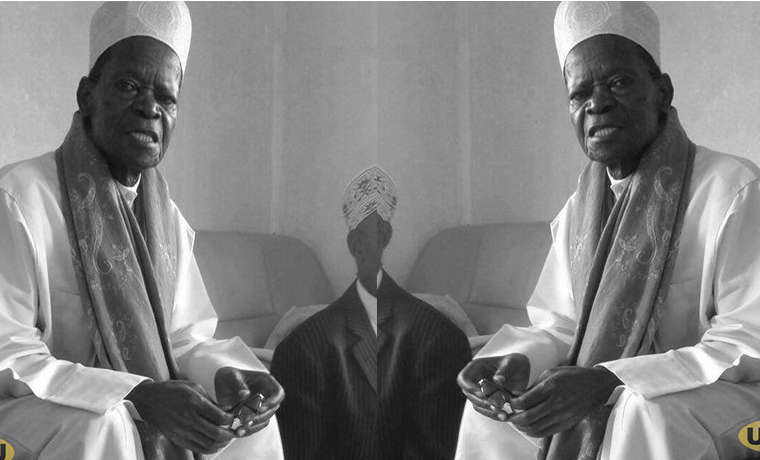
The Muslim community and the Democratic Party are mourning the death of Sheikh Abdul Kadir Mbogo. The Muslim cleric and veteran died on Friday evening at the age of 96, according to the Uganda Muslim Supreme Council. In his condolence message, His Eminence Sheikh Shaban Ramadhan Mubaje, the Mufti of Uganda, described the deceased as a pious Muslim who lived an illustrious life.
He also said he was a devoted servant of Islam who spent his entire life preaching, teaching, and guiding the Muslim community. “Sheikh Mbogo served the Muslim community wholeheartedly with total dedication and has left an outstanding legacy as a principled and loyal person,” the Mufti said in his condolence message. Mubaje added that the deceased was soft-spoken, humble, and wise, and lived in line with the teachings he delivered from the Holy Qur’an and the sayings of Prophet Muhammad throughout his decades of service.
The Mufti directed that funeral prayers be held at the National Mosque, where the late cleric served for many years, shortly after the Dhuhr congregational prayers on Saturday, June 13, 2026. He also called on Muslims to attend in large numbers.

Sheikh Mbogo began his service in the 1950s. He later served as chief preacher at the National Mosque in Old Kampala and as Kadhi of Kampala Muslim District from 1972 until retirement about a decade ago. His influence spanned more than seven decades. He served as preacher, teacher, Kadhi, historian, institution builder, and politician. He remained a steady presence through major transitions in Uganda’s Muslim leadership structures. Born on March 13, 1930, in Ntinda – Kampala, he was the seventh of fifteen children. His father, a Muslim teacher, shaped his early religious foundation.
Mbogo later received a scholarship and travelled to Yemen for Islamic studies, a rare opportunity at the time that strengthened his scholarship and leadership path. After returning in 1951, he served as Imam of Abdul-Azziz Bulwadda Mosque in Kampala. He also supervised community religious duties in Bakuli. He rose to Kampala District Kadhi in 1963, shortly after independence. He later became chief preacher at the National Mosque while still serving as Kadhi, a dual role that expanded his influence in religious guidance.
In the 1970s, he emerged as one of the key figures behind efforts to unite Uganda’s fragmented Muslim community. Working with other Muslim leaders and intellectuals, he played a central role in discussions that led to the formation of the National Association for the Advancement of Muslims (NAAM), a key step in the push for Muslim unity. During this period, he also pushed youth outreach and mosque development. His work supported the expansion of Muslim institutions across the country.
One of his major contributions came through the establishment of Kibuli Hospital. In the early 1980s, he, along with Muslim leaders, joined in mobilising resources for the project. He worked alongside Hajj Katerega Namuguzi, Hajj Eriasa Sevviiri, and Sheikh Muhammad Kibanga, among others. Mbogo travelled widely to rally support for the project, which was later set up and built on land donated by Prince Badru Kakungulu.
Colleagues often cited his integrity during the project. One recalled a case involving surplus construction materials. “Rather than keeping quiet about the surplus, Sheikh Mbogo informed supporters and sought guidance. The remaining materials were sold, and the proceeds returned to the project,” a colleague said. He also contributed to Islamic scholarship through writing. His book Ebyafaayo by’Obusiraamu documented key events and personalities in Uganda’s Muslim history.
It remains a reference point for historical memory within the community. Sheikh Mbogo also played a political role as a founding member of the Democratic Party. He stood out as one of the prominent Muslim figures in a party often associated with other faith groups. After retirement, he remained active as an adviser within Muslim leadership structures. He served in the Mufti’s advisory circles and mentored younger leaders.
His influence extended beyond religious affairs. In politics, Sheikh Mbogo held a distinct position as one of the founding members of the Democratic Party, currently the oldest political party in Uganda. At the time when the deceased joined other founding members of this party, political and religious identities often overlapped, with the Democratic Party widely associated with the Catholic Church.
He challenged the view that the party belonged to a single religious group, and he often said his loyalty to the party came from its commitment to truth, justice, freedom, and human dignity. Democratic Party President General Norbert Mao described him as a patriot who served both Uganda and Islam with distinction.
“With humble acceptance of God’s will, we condole with his family and the Muslim community and pay tribute to him for his dedicated service to Uganda and Islam since the days of the legendary Prince Nuhu Mbogo,” Mao said. Many leaders who interacted with him remember a man committed to unity, mentorship, and service.
He consistently encouraged leaders to prepare successors, nurture young talent, and place the interests of the community above personal ambitions. Mukono Municipality Member of Parliament Betty Nambooze recalled how he donated land for schools and mosques and remained steadfast in defending community institutions. She particularly remembered his efforts in protecting Kiwanga Ummah Primary School from land grabbers.
Dr. Lulume Bayiga, a longtime associate in the Democratic Party currently in the PFF, described Sheikh Mbogo as a peace-loving leader whose commitment to justice, freedom, human rights, and inclusiveness inspired many across religious boundaries. “Sheikh Abdul Kadir Mbogo is a democrat, a father, and a peace-loving, inspirational Islamic preacher. I will always remember him for loving and working for the Democratic Party and for the values of truth, justice, peace, freedom, human rights, inclusiveness, and equality.”
According to arrangements, Sheikh Abdul Kadir Mbogo will be laid to rest at Kiwanga in Namamve. He leaves behind a legacy built on faith, integrity, scholarship, unity, and service, values that defined his life and earned him respect far beyond the Muslim community-URN. Give us feedback on this story through our email: kamwokyatimes@gmail.com