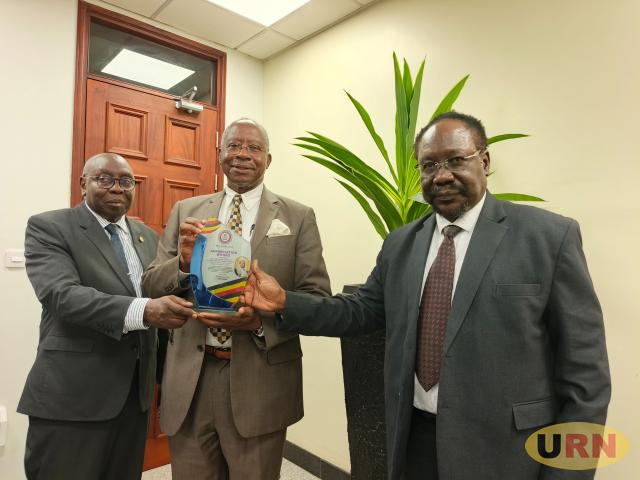
Retiring Court of Appeal and Constitutional Court Judge, Justice Dr. Frederick Martin Stephen Egonda-Ntende, has said he is leaving the Judiciary as a satisfied parent after witnessing the technology reforms he helped initiate nearly three decades ago grow into mature systems that are transforming the administration of justice in Uganda.
Speaking after receiving an Appreciation Award from the Judiciary’s ICT and Documentation Committee on Thursday in Kampala, Justice Egonda-Ntende compared the evolution of the Judiciary’s technology agenda to raising a child from infancy to adulthood.
“At this stage, I am like a parent. You see your child grow from a toddler to an infant, a young lad and then an adult of age to make their own decisions. So I think I go away as a satisfied parent,” Justice Egonda-Ntende said.

The award ceremony was held in Chief Justice Dr. Flavian Zeija’s boardroom at the Supreme Court, where members of the ICT and Documentation Committee honoured Justice Egonda-Ntende for his pioneering role in introducing and advancing information and communication technology within the Judiciary.
In his acceptance speech, the veteran jurist recalled that his passion for technology in judicial work dates back to a professional fellowship at the University of Minnesota in the United States in 1996 and 1997, where one of his areas of focus was courts and technology.
Upon his return to Uganda, Justice Egonda-Ntende advised the then Chief Justice, Benjamin Odoki Wambuzi, to establish a technology committee to guide the Judiciary on the adoption of technology.
“I wrote a report and said one of the first things perhaps we should do is set up a technology committee that would advise on matters of technology. He did that and asked me to chair it,” Justice Egonda-Ntende said.
Nearly 30 years later, the committee has evolved into a key driver of the Judiciary’s digital transformation, overseeing reforms ranging from electronic case management to virtual court proceedings.
Justice Egonda-Ntende also reflected on what he considers his most significant contribution to Uganda’s legal profession, saying it was not the judgments he authored but his support for the creation of the Uganda Legal Information Institute (ULII).
“People may think it is the decisions I have written. I beg to differ. If I was to pick one thing that perhaps I did and did right and has had the most profound effect on the legal profession, it is supporting the creation of the Uganda Legal Information Institute,” he said.
ULII, established in 2007, provides free online access to court decisions, legislation, and other legal materials. It has since evolved into an artificial intelligence-driven legal information platform and is among the Judiciary’s most accessed digital services.
While reading the citation, Court of Appeal and Constitutional Court Justice Geoffrey Kiryabwire praised Justice Egonda-Ntende’s distinguished judicial career and his pioneering contributions to the use of technology in court administration.
According to the citation, Justice Egonda-Ntende served as the first chairperson of the Judiciary’s Technology Committee in 1997 and spearheaded the development of the Computerized Case Administration System (CCAS), which laid the foundation for today’s Electronic Court Case Management Information System (ECCMIS). He was also credited with introducing court recording and transcription technology in Uganda’s Judiciary, pioneering video conferencing for commercial disputes while serving as head of the Commercial Court around 2005, championing electronic filing and virtual court processes, and leading the establishment of ULII.
Presenting the award, the Chairperson of the ICT and Documentation Committee, Supreme Court Justice Christopher Izama Madrama, described Justice Egonda-Ntende as a visionary who foresaw the role technology would play in improving access to justice long before it became a central part of judicial administration.
Justice Madrama said Uganda’s Judiciary owes much of its digital transformation to Justice Egonda-Ntende’s leadership, noting that his efforts helped move courts away from cumbersome paper-based processes to modern electronic systems.
“We owe a lot to this pioneering work and the development of electronic systems which are now taking the Judiciary into the future,” Justice Madrama said. He added that Justice Egonda-Ntende’s reforms have positioned the Judiciary to benefit from emerging technologies, including artificial intelligence, while improving efficiency, transparency and access to justice.
Justice Egonda-Ntende, who has served as a High Court judge, Justice of the Court of Appeal and Constitutional Court, Chief Justice of Seychelles, and an international judge in Kosovo and East Timor, previously told a special court session held in his honour in May 2026 that his wife, Margaret, played a significant role in his technological innovations.
He recalled using her laptop in the 1990s to undertake much of his technology-related work. Born in 1956, Justice Egonda-Ntende studied at Makerere University, where he earned a Bachelor of Laws degree with honours.
He later obtained a Postgraduate Diploma in Legal Practice from the Law Development Centre and a Master of Laws degree in Information Technology and Telecommunications Law from the University of Strathclyde in Glasgow, United Kingdom.
Throughout his career, he has served in several judicial capacities, including Chief Justice of the High Court of Seychelles (2009–2014), Acting Justice of the Supreme Court of Uganda (2008–2009), International Judge with the United Nations Mission in Kosovo (2002–2004), Judge of the Court of Appeal of East Timor (2000–2001), Justice of Uganda’s Court of Appeal and Constitutional Court (2000–2026), and Judge of the High Court of Uganda (1991–2000). Justice Egonda-Ntende will retire from the Judiciary on June 15, 2026, upon attaining the mandatory retirement age of 70 years-URN. Give us feedback on this story through our email: kamwokyatimes@gmail.com