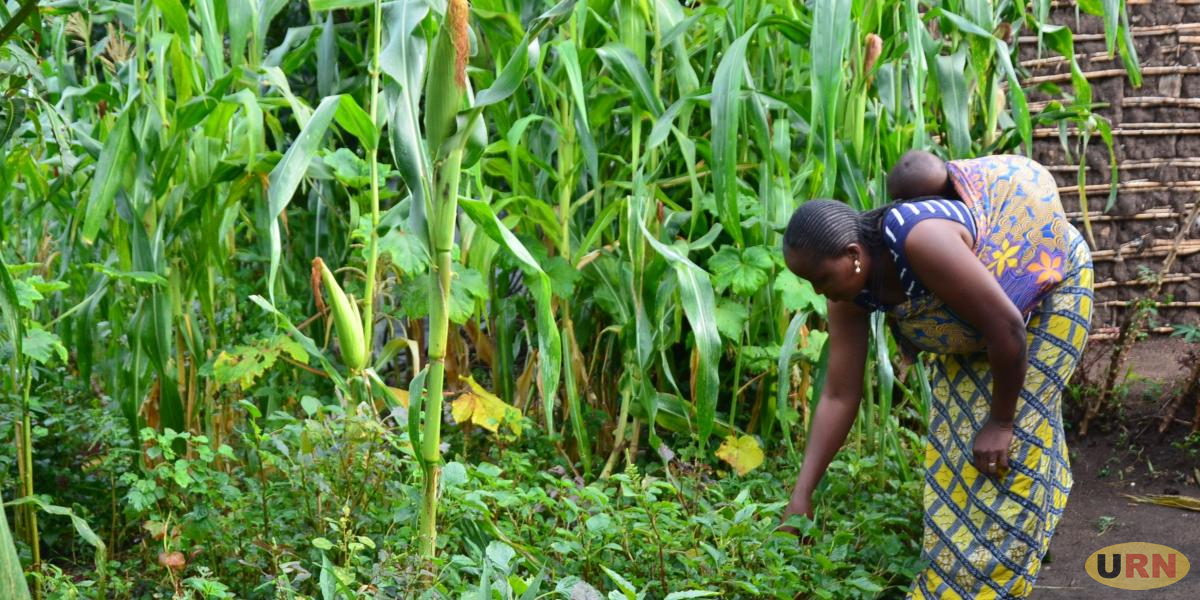
Refugee families in Kyaka II Refugee Settlement are turning to kitchen gardening to improve nutrition among children amid growing food insecurity and rising cases of malnutrition in the settlement.
Kyaka II settlement, located in Kyegegwa district, is home to thousands of refugees who come to Uganda. Among the refugees is 24-year-old Mwamimu Hakiza from Democratic Republic of Congo whose two-year-old son recently recovered from severe malnutrition after she was advised by health workers and fellow refugees to begin growing vegetables at her home.
“My son was not fine, he had developed silky brown hair, a protruding stomach and was thin,” she says. As a first-time mother, Hakiza says she did not understand the warning signs of malnutrition and delayed seeking medical care until a neighbor intervened.

“Then my neighbor Bijoux saw him and referred me to an organization that told me he was sick,” she explains. “They gave him medicine, porridge and advised me to always give him green vegetables.”
She was later encouraged to establish a kitchen garden where she now grows vegetables to feed her son and the the family, her son has fully recovered. Bijoux Yowale, who advised Hakiza on the health of her son, is the leader of Tujitengemee Care Group. The group brings together 10 mothers who are educating other mothers in the settlement how to establish kitchen gardens and the nutritional benefits of vegetables to children, and pregnant mothers.
The group grows vegetables including dodo, cabbages, sukuma wiki, carrots and onions, which are mainly fed to children. “We used to have many malnourished and sickly children, but since we started this group and encouraged families to feed children on vegetables, we are seeing healthier children,” Yowale says.
Besides growing vegetables, the group identifies children showing signs of malnutrition and encourages mothers to seek medical attention. The members also operate a savings scheme and rear pigs, goats and chickens to supplement household incomes.
Yowale says the initiative has helped change misconceptions surrounding malnutrition within the refugee community. “At first, some people thought malnutrition was witchcraft, but when we started feeding children vegetables and saw changes, that myth was broken,” she says.
Pole Pole Kigombe, another refugee and member of the group, says kitchen gardens have improved children’s immunity. “When our children who eat vegetables get sick, they don’t become too weak or lose blood like we see in other children, ours are a bit stronger don’t even get sick easily,” he adds.
Kigombe now trains other refugee families on how to establish kitchen gardens despite limited land inside the settlement. “We hire land from nationals to grow food crops for our families, but these kitchen gardens can be put on the small land we have in the camp,” he says.
These members say the small vegetable gardens are helping them improve nutrition and protect children from malnutrition. Uganda hosts more than 1.8 million refugees and asylum seekers. However, humanitarian agencies have repeatedly warned of malnutrition because of food shortages due to funding constraints, leading to reduced food assistance for refugees.
An October 2025 nutrition assessment conducted by KRC Uganda found that 37.9 percent of children screened in the settlement were stunted, indicating chronic malnutrition. The assessment also identified 62 children suffering from Severe Acute Malnutrition while another 359 children with Moderate Acute Malnutrition. Caroline Uwera, a Nutrition Officer at KRC Uganda says poverty, food insecurity and limited nutrition knowledge continue to fuel malnutrition in the settlement.
She explains that under different programs, KRC trains refugee mothers on exclusive breastfeeding, complementary feeding, hygiene, sanitation and early detection of malnutrition. “Their primary focus is to promote better maternal, infant and young child nutrition practices, while also strengthening early detection of malnutrition within communities,” she adds-URN. Give us feedback on this story through our email: kamwokyatimes@gmail.com