Smallholder farmers in Uganda and across East Africa could get new opportunities to borrow money for irrigation, water harvesting, livestock, storage, renewable energy and other investments that can help them cope with the effects of climate change.
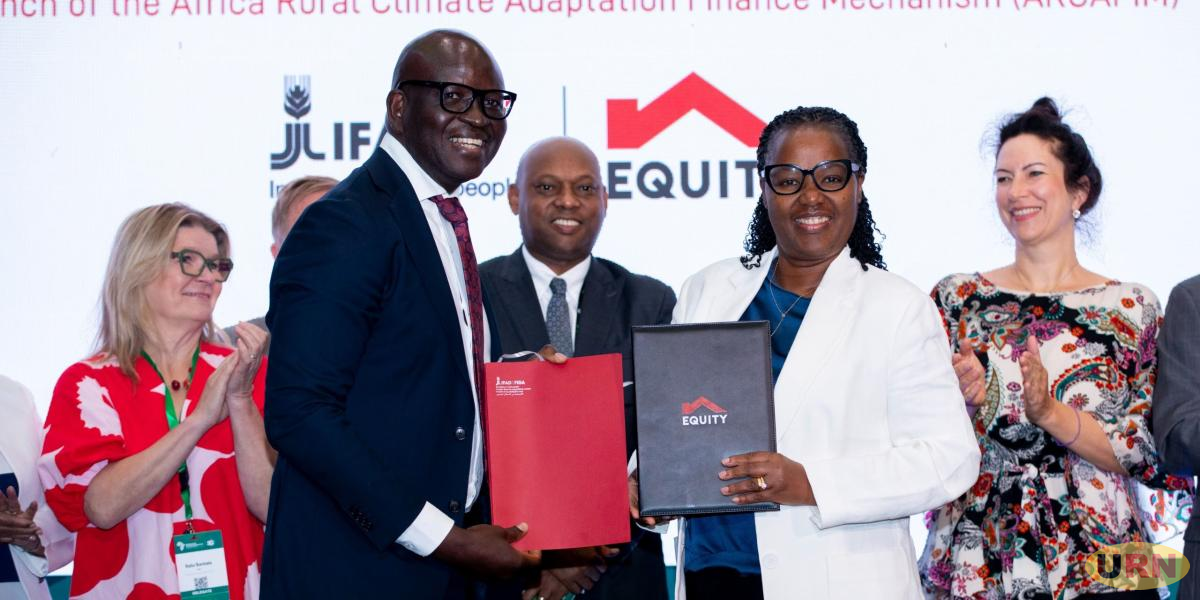
The opportunities are part of a new US$200 million financing mechanism launched by the International Fund for Agricultural Development (IFAD) and Equity Group to help farmers and rural businesses invest in climate-resilient agriculture.
The Africa Rural Climate Adaptation Finance Mechanism (ARCAFIM) launched at the Africa Food Systems Forum 2026 in Kigali, Rwanda, will operate in Uganda, Kenya, Tanzania and Rwanda over the next 12 years.

The programme is expected to reach about 260,000 smallholder farmers and 500 rural micro, small and medium-sized enterprises (MSMEs). At least 50 per cent of the intended beneficiaries will be women, and 30 per cent will be young people.
The fund is designed to finance practical investments that can help farmers deal with changing weather patterns, unreliable rainfall, drought and other climate-related risks. A farmer could, for example, seek financing to install irrigation, construct water-harvesting facilities or improve livestock production.
Others could use the financing to invest in better storage facilities to reduce post-harvest losses, renewable energy or equipment for climate-resilient agro-processing. This means that climate adaptation will not only be about changing farming practices. Farmers will also have access to financial support to invest in the equipment, technologies and infrastructure needed to make their farms and businesses more resilient.
The programme will provide financing directly to farmers and agricultural producers and through microfinance institutions, savings and credit cooperatives (SACCOs) and companies involved in agricultural value chains. Farmers will also receive technical support to help them identify investments that can genuinely protect their farms and businesses from climate risks.
ARCAFIM has been designed to address one of the biggest problems facing smallholder farmers: getting financial institutions to lend to them on reasonable terms.
Farmers are often considered high-risk borrowers because their ability to repay loans can be affected by drought, floods, changing rainfall patterns, pests and other factors beyond their control. Under the fund, development-finance partners will help absorb some of the lending risks, while Equity Group will put its own money into the programme. Of the US$180 million set aside for lending, Equity Group will contribute US$90 million from its own balance sheet, matching the concessional financing from development partners.
This risk-sharing arrangement is intended to encourage financial institutions to increase lending to farmers and rural businesses. Because the lending capital will be reused over about four investment cycles, it is expected to generate approximately US$266 million in loans over the life of the programme.
About US$20 million of the US$200 million programme has been set aside for technical assistance. This money will be used to strengthen the ability of microfinance institutions and SACCOs to provide climate-adaptation loans and to help farmers and rural enterprises understand which investments are most suitable for their needs. The support will cover areas such as irrigation, water harvesting, dairy and livestock resilience, post-harvest storage, renewable energy and climate-resilient agro-processing.
For a farmer, this could mean not only having access to a loan, but also getting guidance on what to invest in, how that investment can reduce climate-related losses and how it can improve production and income.
Overall, the initiative is expected to strengthen food security for about 1.2 million people and benefit an estimated 1.5 million people directly and indirectly.
Equity Bank Kenya Managing Director Moses Nyabanda said the programme would help farmers and agricultural businesses adapt, increase production, grow their revenues and incomes and become more resilient to climate change.
IFAD and Equity Group want climate-resilience financing to become a normal financial service that banks and other financial institutions continue offering after the programme ends. IFAD Vice President Gérardine Mukeshimana said the goal was to make rural climate adaptation a viable and sustainable business line for African financial institutions.
The Green Climate Fund has committed US$55 million to the programme. Other financing partners include the Ministry for Foreign Affairs of Finland, the Nordic Development Fund, the Government of Denmark and the European Union.
If the model succeeds in East Africa, IFAD and Equity Group plan to explore extending it to other parts of Africa, with Southern and West Africa identified as potential next regions.
For East African farmers, the immediate opportunity is to use climate finance to make their farms and businesses stronger: invest in water, improve production, reduce losses, adopt better technology and build enterprises that can continue earning even as the climate becomes less predictable-URN. Give us feedback on this story through our email: kamwokyatimes@gmail.com