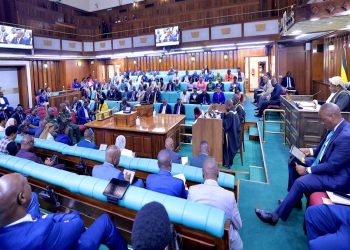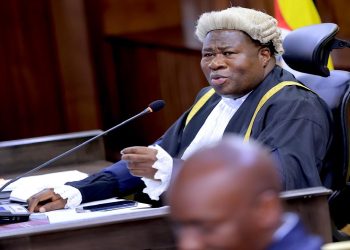


The Speaker Jacob Markson Oboth says Parliament is fully committed to strengthening legislative frameworks, expanding training for lawmakers and addressing the plight of Ugandan migrant workers.
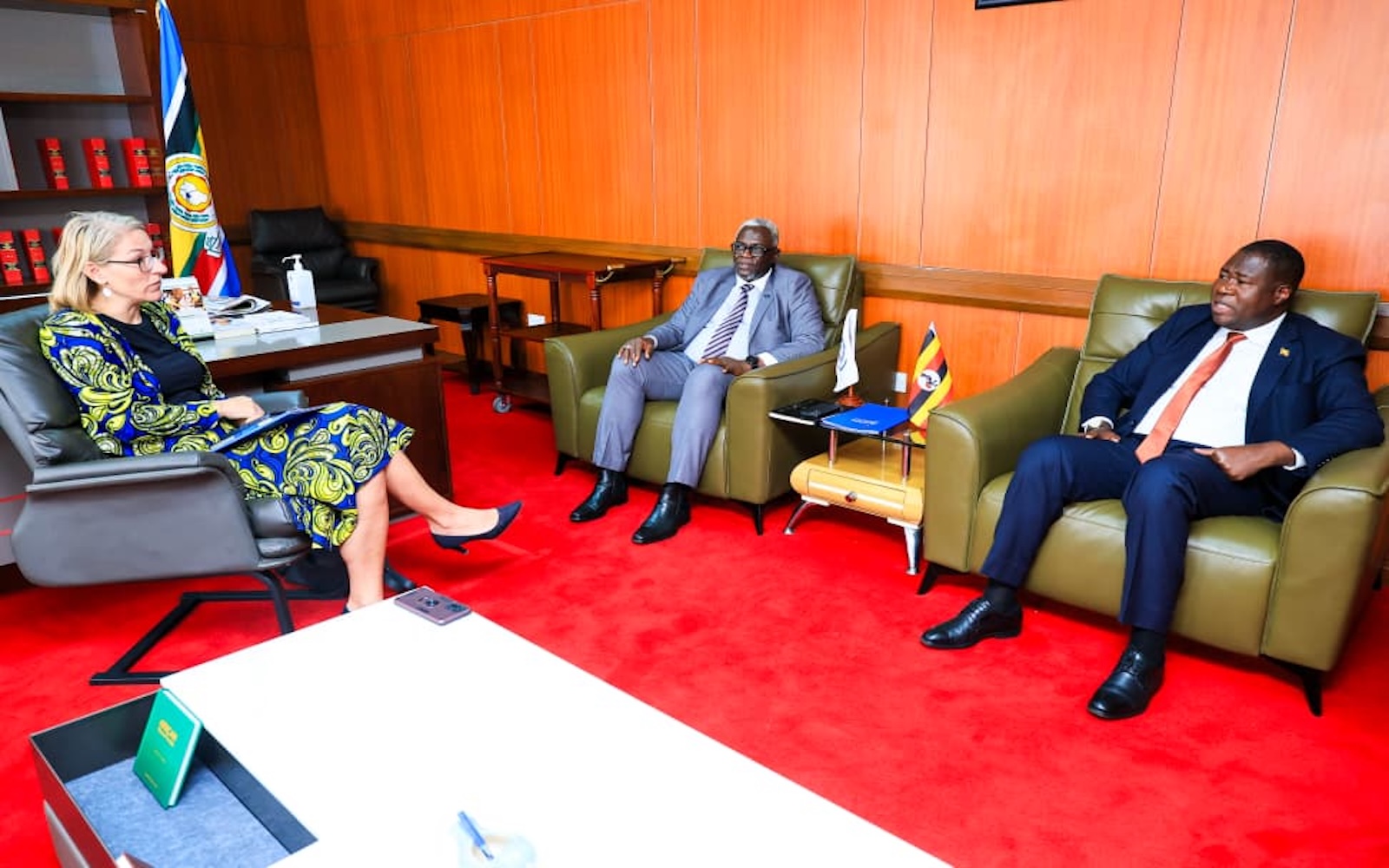
Oboth made the pledge as he met the Chief of Mission for the International Organisation of Migration (IOM) in Uganda, Mr. Sanusi Tejan Savage.
Savage had paid a courtesy call on the Speaker on Wednesday, 11 November 2026.
Oboth praised the IOM for its humanitarian interventions and emergency responses across the country, positioning Parliament as the primary voice and refuge for citizens facing distress abroad.

Highlighting the grave challenges confronting Ugandans working overseas, the Speaker revealed that his office frequently receives desperate appeals from distressed families.
He raised concern about impoverished households that sell land to send their children abroad, only to face tragic outcomes without structured state support to repatriate the deceased.
“Death can occur anywhere but as Africans, our culture dictates that a person who has died should be accorded a respectful burial,” Speaker Oboth said calling on the IOM to help influence government policy so that mechanisms are established to support families in bringing home the remains of departed Ugandans.
The Speaker also drew attention to petitions currently before Parliament concerning Ugandans lured abroad into human trafficking, forced labour, sexual exploitation and drug rings, as well as citizens trapped in foreign conflict zones such as Russia and Ukraine.
To close existing policy and legal gaps, Speaker Oboth endorsed a proposal to introduce dedicated anti-smuggling legislation in Uganda.
The Speaker suggested that a Private Member’s Bill can be proposed to fast-track compliance and strengthen legal tools against human smugglers. He said parliamentary oversight and legislative reviews on migration and border governance would be channelled through the Parliamentary Committee on Defence and Internal Affairs.
Savage reaffirmed IOM’s partnership with Uganda which dates back to 1988. He outlined the organisation’s contributions which include deploying health surveillance equipment at airports and border points during the Ebola and COVID-19 outbreaks and resettling more than 15,000 refugees globally from Uganda since 2020.
He added that IOM has facilitated charter flights to safely repatriate hundreds of stranded Ugandans from the Gulf region and East Asia.
He also proposed a structured interface between Parliament, the National Coordination Mechanism on Migration under the Office of the Prime Minister and the Inter-Ministerial Platform for Migration Coordination.
The IOM delegation also briefed the Speaker on a green technology project in the Bidibidi refugee settlement, home to what it described as the world’s first refugee-operated lithium battery re-purposing laboratory. He revealed that the facility turns electronic waste into sustainable solar power solutions for host and refugee communities-Ug. Parliament. Give us feedback on this story through our email: kamwokyatimes@gmail.com