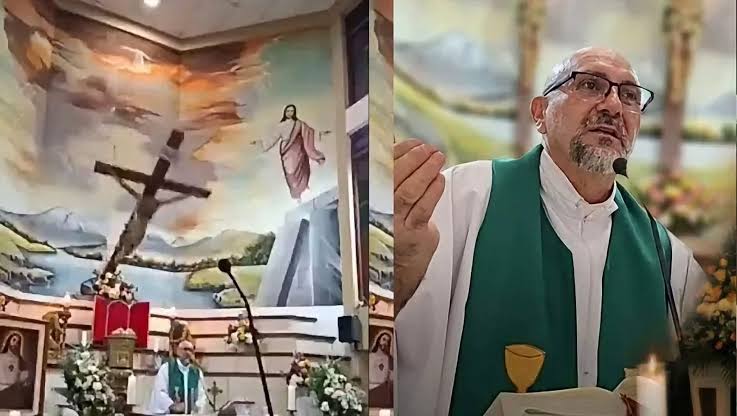
Over the weekend, a Roman Catholic priest in Guayaquil, Ecuador, died after a heavy wooden crucifix detached from the wall behind the altar and struck him on the head while he was celebrating Mass. Fr Patricio Alfredo Sánchez Molinari, a parish priest at Our Lady of Perpetual Help Church in the Central Vicariate of the Archdiocese of Guayaquil, was addressing the congregation, reportedly during or around the homily.
According to media reports and the circulated video, he had been speaking about the fleeting nature of life and the importance of dedicating time to God and loved ones when the cross fell. Footage captured the moment. Worshippers cried out for help and an ambulance. The Archdiocese of Guayaquil, in a statement signed by Cardinal Luis Gerardo Cabrera Herrera, confirmed his death the same day without specifying the precise medical cause, noting that he had “departed for the Father’s House to rejoice in His presence and glory.”
The video circulated widely on social media and prompted news coverage, including discussion among Catholics in Uganda and elsewhere. A practical and theological question quickly arose: what happens next in the liturgy when the celebrant is suddenly incapacitated or dies? A local popular belief among some Catholics holds that the priest’s body must remain on the altar until another priest finishes the Mass. Church norms do not require this. The guiding principles prioritise the priest’s life and safety, reverence for the Eucharist once consecrated, and an orderly pastoral response.

In interviews on the matter, Rev Fr Joseph Mukasa Nkeera, assistant priest at Ggaba Parish and former long-time director of communications for the Archdiocese of Kampala, said the immediate priority is always medical care. Nkeera emphasised that church guidance balances three priorities: care for the human person, protection of the Eucharist, and the dignity of the liturgy. “First aid should be given, emergency services called, and the priest moved if needed for treatment. There is no liturgical rule that overrides this. Those attending must help maintain calm and order,” he said.
Fr Nkeera, who once had Mass interrupted when soldiers removed him from the altar, stressed that safety and health come first. If the incident is minor and the priest can continue, the Mass proceeds. Otherwise, the stage of the liturgy determines the next steps. “If anything happens to the main celebrant, we look at safety and health first, and if what has happened is minor and he can carry on… No problem. If he can’t, then we ask at which stage the Mass is. The stage is critical,” he said.
He added that if the Mass is still in its early stages, it can be ended. “Like in my case, when I was picked, the Mass ended. But also if the priest had started the Mass and then a big rain starts, or the church catches fire? What happens… It’s common sense that we end there.” Rev Fr Charles Jjuuko, Masaka Diocesan chancellor, noted that in the Ecuador incident the Mass would end because the celebrant was giving the homily.
Jjuuko also added that if the Mass is midway, it ends. It can’t be resumed but rather restarted. “When this Mass ends, it ends, and even if they resume at a different time or date, they begin from the beginning,” he said. Fr Nkeera weighed in further, saying Mass is not a movie that can be paused and resumed from the exact liturgical moment days later by the same or a different assembly as a continuation of the identical celebration.
“Once ended, any later Mass starts from the beginning… When the Mass ends midway, for whatever reason, we don’t just resume. Someone might think that if we were at second reading, we just start from there. No, we start afresh,” he noted. Church guidance draws primarily from older norms such as De Defectibus (On Defects That May Occur in the Celebration of Mass), a section of the traditional Roman Missal issued under Pope St Pius V in the 16th century that addresses problems arising during Mass, whose underlying principles remain applicable.
The General Instruction of the Roman Missal (GIRM) provides the framework for celebration but does not detail every contingency of sudden incapacity; the traditional norms and moral-theological commentaries supply the situation as assessed by those present. According to De Defectibus, if before the Consecration the priest becomes seriously ill, faints, or dies, the Mass is discontinued. If this happens after the consecration of the Body only, or after both species have been consecrated, the Mass is to be completed by another priest from the point of interruption (and in necessity even by a priest who is not fasting).
Consecration is the central moment of the Mass. It is when the priest, acting in the person of Christ, says the words of institution over the bread and wine. Catholics believe that at this point the bread and wine become the Body and Blood of Christ (the consecration of the Eucharist). Before the words of institution, the Eucharist has not yet been confected. There is no sacramental reality that must be completed. The Mass is discontinued. Another priest does not take over the same celebration as a simple continuation; any later Mass begins afresh.
In the Ecuador case, reports place the incident during the homily, well before the Liturgy of the Eucharist and consecration. So the Mass would simply end. Fr Nkeera and Fr Jjuuko both noted that the situation is different once the priest has reached or passed the consecration. “The teaching of the Church is that, after caring for the affected celebrant, if there is a co-celebrant, he must ensure that he finishes the consecration, consumes the sacrament, and ends Mass,” Fr Jjuuko said.
He added that if the sacred species (the consecrated bread and wine, now believed to be the Body and Blood of Christ) are present, they must be treated with the greatest reverence. “If another priest or concelebrant is available, he continues the Mass from the interruption point and brings it to a proper conclusion.” He noted that continuity at this stage respects the integrity of the liturgical action once the sacramental threshold has been crossed.
Available church documents show that if no other priest is available, the celebration cannot be completed by a deacon or layperson. The consecrated hosts and the chalice (if consecrated) are placed reverently in the tabernacle by a deacon or authorised minister and safeguarded until a priest can act. Only in rare extreme situations, such as imminent danger of profanation or inability to preserve them, might the species be consumed.
According to Catholic norms, no one other than a priest may complete the Eucharistic Prayer or perform the priestly actions of the Mass. In places where no other priest is available, those present protect the sanctity of the sacrament. These principles are confirmed by authoritative liturgical commentators. Legionary of Christ Father Edward McNamara, professor of liturgy at the Pontifical Athenaeum Regina Apostolorum and long-time liturgy columnist for Zenit/EWTN, explained the same norms in detail.
“After consecration of either or both species, if the priest cannot continue and is unlikely to recover within about an hour, there is a grave obligation for another priest to complete the Mass. If none is immediately available, the species are reserved in the tabernacle. Only extreme circumstances permit consumption without completion. Before consecration, the Mass is simply discontinued, ” Fr McNamara noted-URN. Give us feedback on this story through our email: kamwokyatimes@gmail.com