For more than three decades, President Yoweri Museveni has championed the idea of transforming East Africa into a single political entity, arguing that political integration would give the region the economic, security, and geopolitical weight needed to compete with global powers.
But as the East African Community expands, Museveni’s long-standing dream of a Political Federation remains out of reach.
Instead, the region has adopted Political Confederation as a transitional step towards federation, a development that raises questions about whether Museveni is changing course on an ambition he has pursued since the revival of the EAC in the early 1990s.

The evidence, however, points less to an abandonment of the federation and more to a retreat from the fast-track approach Museveni once championed.
The Treaty establishing the East African Community provides for Political Federation as the ultimate stage of regional integration.
Article 123 provides for cooperation in political matters and directs the Summit of EAC Heads of State, the Community’s supreme organ, to initiate the process towards establishing a Political Federation by directing the Council of Ministers to undertake the process.
The Treaty envisages four stages of integration: a Customs Union, a Common Market, a Monetary Union and ultimately a Political Federation.
Its objective is to strengthen and regulate the industrial, commercial, infrastructural, cultural, social and political relations of the Partner States and promote accelerated, harmonious and balanced development.
When the EAC was revived in the early 1990s after its collapse in 1977, Museveni strongly advocated for Uganda, Kenya and Tanzania to eventually become one political entity.
His vision later expanded with the growth of the bloc, which now has eight members. Museveni has particularly supported the inclusion of the Democratic Republic of Congo, Somalia and South Sudan, arguing that a wider political bloc would make it easier to address regional insecurity and strengthen the region’s collective capacity.
At the heart of his argument is the belief that the borders inherited from colonial rule have left East African countries too small and strategically vulnerable.
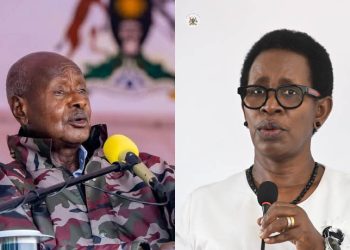
Speaking recently to army officers at the Senior Staff College-Kimaka in Jinja, Museveni again argued that political integration was necessary if Africa was to protect its interests against major global powers.
“We must go to the moon and find the Americans there, find the Chinese, Russians and Indians; we tell them that this also belongs to us. If you’re not going to be just a Boy Scout movement and be able to defend Africa, we must be able to operate on land, air, navy and in space, but can Uganda have a space program? Or can we go to the ocean? No, we are cut off by the irrational colonial borders,” he said.
Museveni then blamed the slow pace of integration partly on political leaders unwilling to give up their national power.
“That’s why the answer there is political integration. We have been talking about the East African Integration, but if Presidents want to remain big fish in the small ponds, then that issue will not be addressed,” he said.
His vision of federation includes a single market and shared strategic capabilities, including military cooperation on land, in the air, at sea and eventually in space.
Yet the political reality of the EAC has repeatedly frustrated the push for a rapid federation. In August 2004, Museveni supported the creation of a committee to find ways to “expedite and compress” the regional integration timetable.
The Amos Wako Committee subsequently recommended fast-tracking the Political Federation.
In October 2006, Uganda launched its national consultative process to advance the fast-track mechanism.
But Tanzania and other Partner States were reluctant to move so quickly. Concerns centred on national sovereignty and the danger of creating a political federation before sufficient trust and institutional safeguards had been developed.
By then, the EAC had expanded to five countries with the admission of Rwanda and Burundi.
At the 18th Summit of EAC Heads of State, held in Dar es Salaam on May 20, 2017, the leaders adopted Political Confederation as a transitional model towards the East African Political Federation.
The Summit directed the Council of Ministers to constitute a team of constitutional experts to draft a Constitution for the proposed Political Confederation.
The decision did not remove federation from the EAC agenda. Instead, it introduced another stage between the existing Community and the ultimate political union.
A confederation is a union of sovereign states that cooperate for common purposes while retaining their independence.
The central authority derives its legitimacy from the member states and remains subordinate to them.
Under a federation, the constituent states form one sovereign political entity, with a central government exercising constitutionally defined powers across the federation.
Under a confederation, Uganda, Kenya, Tanzania and the other Partner States would retain their national governments, laws and political sovereignty while transferring agreed responsibilities to a common regional authority. Under a federation, the countries would ultimately become one political entity.
Fred Mukasa Mbidde, a lawyer and former member of the East African Legislative Assembly, believes Museveni’s original ambition was too optimistic.
“Federation means declaration of the EAC as one country. No more different legislation, judicial and executive matters, basically a single country. It was too optimistic,” Mbidde says.
“But confederation would build confidence, a precursor for a political federation,” he adds.
Mbidde argues that the political leadership has been one of the biggest obstacles to deeper integration.
He says citizens and professional organisations are often moving faster than governments.
“Professional organisations like the Law Societies have carried out joint regional initiatives, yet the leaders are still fighting intra-regional trade through the imposition of non-tariff barriers,” he says.
For him, governments have therefore failed to match their political declarations on integration with action that removes barriers between the Partner States.
The Common Market, established through a 2009 protocol, provides for the free movement of goods, persons, labour, services and capital, as well as the right of establishment and residence.
The free movement of labour, for example, remains restricted to specified categories of workers, mainly highly skilled professionals, administrators, managers and workers in technical and specialised fields.
Citizens moving between Partner States for employment can still face administrative requirements, including work permits, despite the Common Market’s commitment to facilitate the movement of workers. Businesses also continue to encounter non-tariff barriers despite the existence of the Customs Union and Common Market.
These limitations raise a difficult question for the political federation project: if the region is still struggling to fully implement economic freedoms already agreed upon, how ready is it to surrender national political powers?
The EAC convergence framework requires Partner States to work towards a national debt ceiling of 50 percent of GDP, inflation of no more than eight percent, foreign exchange reserves of at least 4.5 months of import cover and a fiscal deficit not exceeding three percent of GDP.
But the countries remain at different levels of economic and fiscal preparedness. Bank of Uganda Governor Michael Atingi-Ego has warned that the 2031 deadline for the Monetary Union is too ambitious because Partner States are not moving towards economic convergence at the same pace.
Under the revised roadmap, countries are expected to meet all four convergence criteria by 2028 and maintain them for three consecutive years before 2031.
Experts have questioned whether countries with significant fiscal differences can make the required adjustments within that period.
This is significant because the Monetary Union is itself only the third stage of a process whose final destination is political federation.
The slow progress therefore illustrates the scale of the challenge facing Museveni’s larger political ambition.
Even the transitional confederation has not been easy to establish. Following the 2017 Summit decision, a team was established in 2019 to consult citizens and stakeholders and develop a model for the proposed confederation.
The consultations were initially expected to take about a year and conclude in 2021. Instead, the process has stretched for years.
The consultations have so far covered Uganda, Burundi, Kenya and Rwanda. Uganda completed its process first, followed by Kenya in 2023 and Rwanda in June this year.
The outcome of the consultations is expected to inform the Heads of State on the roadmap and structure of the Political Confederation.
Benjamin Odoki, the retired Chief Justice of Uganda and chairperson of the team of experts developing the framework, says the region must resist the temptation to rush the process.
“This is a possible transition to the ultimate goal of establishing a fully fledged political federation of East Africa, one government, one people, one country,” Odoki said during a consultative session in Kigali in June.
Odoki says the region must first agree on the model before drafting a constitution.
“In other constitutional processes, proposals are often accompanied by a draft constitution. But in this case, we must first agree on the model before drafting the constitution, so that we do not waste time developing something that may not be adopted,” he said.
The experts must determine which powers would remain with the sovereign states and which would be transferred to the centre.
“We must decide which areas of cooperation fall under the confederation, which powers remain with sovereign states, and which are transferred to the centre. We must determine whether there will be a president, a chairperson, or a cabinet, and how the institutions will function,” Odoki said.
Uganda appointed Justice Benjamin Odoki and Professor Murindwa-Rutanga as its representatives on the EAC team tasked with developing the confederation framework and Constitution.
Uganda’s active participation suggests that Kampala has not abandoned the federation project. Instead, it is working within the transitional model agreed by the regional Heads of State.
The EAC’s experience exposes a growing gap between the ambition of regional integration and the political willingness to surrender national powers. The Community has expanded rapidly, but its integration has not kept the same pace.
The original three-member Community has become an eight-member bloc, yet the countries continue to struggle with non-tariff barriers, labour mobility, economic convergence and the harmonisation of national policies.
Mbidde says political leaders themselves are responsible for much of the frustration.
His criticism goes to the heart of Museveni’s long-standing argument. Museveni has repeatedly said political integration is necessary because individual East African countries are too small to independently protect their economic and security interests in a changing global order.
But the same political leaders whose cooperation is required to create a federation remain reluctant to surrender the powers that make them national leaders.
The question is whether President Yoweri Museveni is reneging on his political ambitions and dream. The evidence does not show that Museveni has abandoned Political Federation.
His recent remarks indicate that he still sees political integration as the ultimate solution to East Africa’s strategic vulnerabilities. What has changed is the route towards achieving it.
Museveni’s earlier attempt to fast-track federation failed to win sufficient regional support.
The EAC instead settled on Political Confederation in 2017 as a transitional model. Uganda is now participating in the development of that model and has provided two senior experts to the constitutional drafting team.
The confederation is therefore not a replacement for federation under the EAC Treaty. It is intended to be the bridge towards it.
But that bridge is taking much longer to build than Museveni originally envisaged.
The irony is that the President who has spent years warning that East Africa cannot afford to remain divided is now working within a process that requires prolonged consultations, institutional negotiations and gradual confidence-building.
The region has also expanded faster than it has integrated. That may strengthen the EAC’s geopolitical importance, but it also makes political federation more complicated, given the different political systems, economies, security interests and national priorities of its eight members-URN. Give us feedback on this story through our email: kamwokyatimes@gmail.com