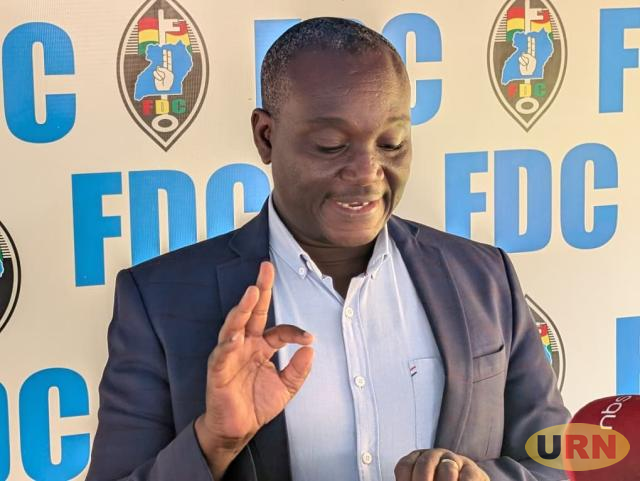
Ugandans are increasingly being pushed into predatory money lending and costly asset-financing schemes because of limited access to affordable credit, the Forum for Democratic Change (FDC) has warned. The party says the resulting debt trap is forcing some borrowers to risk losing their land, homes, livestock and motorcycles, while exposing boda boda riders to financial insecurity.
“There is one condition that makes predatory lending possible: poor access to affordable credit,” FDC Vice Chairperson Robert Centinary Franco said in a media briefing on Monday. “Ugandans turn to moneylenders because they are accessible while formal credit does not reach them,” he added. FDC said more than half of adult Ugandans have borrowed money in the past five years, with many relying on money lenders, mobile lending applications and asset-financing companies instead of banks.
The party said the registered money-lending sector alone handles more than Shs1 trillion annually through about 1,800 licensed lenders, while mobile lending apps and informal lenders have expanded access to credit outside the conventional banking system. FDC said some borrowers end up surrendering land, homes and livestock after failing to repay loans.

In some cases, borrowers are allegedly persuaded to surrender national identity cards and sign documents presented as loan agreements but structured as property sale agreements. “When they default, there is therefore no conventional loan to dispute,” the party said. FDC also described the boda boda sector as a major destination for unemployed and underemployed young people who have limited alternatives in the formal job market.
“The boda boda economy has become one of the main destinations for Uganda’s unemployed and underemployed youth, absorbing large numbers of people whom the formal job market has no room for, without adequate safety nets, insurance, or dignity,” Franco said. The party said most riders do not own their motorcycles outright when they enter the sector. Instead, they acquire them through hire-purchase arrangements requiring daily or weekly payments.
FDC said a rider who falls behind on payments can have the motorcycle repossessed even after paying substantial amounts, leaving them without their main source of income. “When the bike is taken, the rider’s income stops the same day,” the party said, warning that some affected riders may turn to crime after losing their livelihood.To address the problem, FDC proposed cheap capital with minimal collateral requirements for vulnerable groups, farmer banks in agricultural zones, and the restoration of the Cooperative Bank. The party also proposed leadership SACCOs at parish, sub-county and district levels, backed by direct capitalisation, and a Boda Boda Savings and Protection Cooperative Scheme to provide riders with medical, pension and accident cover.
FDC further called for enforcement of existing laws against illegal and unregistered money lenders and digital loan applications that use “threats, blackmail, and harassment” to recover debts. FDC also criticised the government’s mobile money tax policy, arguing that ordinary Ugandans are being taxed repeatedly as the same money moves through the economy. “Government is taxing the same shilling repeatedly as it moves through a worker’s hands,” Franco said.
The party illustrated its argument using the example of a salary earner who first pays PAYE, then incurs excise duty when sending or withdrawing money through mobile money, before paying VAT when the money is used to purchase goods. FDC said the burden is particularly damaging to small businesses and mobile money agents, many of whom depend on transaction volumes for their livelihoods.
“If you pay close attention, many mobile money kiosks are closing, and the cost of doing business is increasing as a result,” Franco said. FDC said more than 150,000 mobile money agents, many of them women and young people, are losing income as transaction volumes fall and some customers revert to cash to avoid the tax. “The government’s tax policy is undermining the same financial inclusion agenda it claims to champion,” the party said.
Franco accused the government of creating a tax system that disproportionately affects ordinary citizens. “This government has built a tax system that punishes the ordinary Ugandan for the basic act of using their own money, while allowing corruption and waste to go untaxed and unaccounted for at the top,” he said.
FDC called on the government to reduce the excise duty on mobile money withdrawals, reverse the 2026 decision to maintain the current rate, and stop applying excise duty to both the withdrawal value and the service fee. The party also urged the government to shift the tax burden towards telecommunications companies, arguing that their profits should be taxed more heavily instead of increasing the cost borne by ordinary mobile money users-URN. Give us feedback on this story through our email: kamwokyatimes@gmail.com