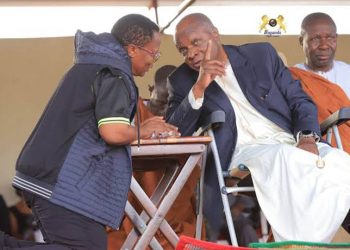
Nnaabagereka Sylvia Nagginda has challenged the Church of Uganda to accelerate efforts toward financial self-reliance, urging every level of the church to establish sustainable income-generating ventures as traditional donor funding continues to decline.
Addressing the opening of the 28th Provincial Assembly, the Church of Uganda’s highest decision-making organ, the Nabagereka said the church must move beyond dependence on external support and strengthen its financial base to sustain its mission. “I urge every level of the church, from province to sub-parish, to pursue self-sustainability through prudent income-generating projects that support mission and ministry,” she said.
“The world now prefers mutual partnerships over dependency. Let dioceses, archdeaconries, parishes and congregations innovate and invest, guided by the Gospel and sound stewardship, so our churches are both spiritually vibrant and economically resilient.”

Nagginda congratulated Archbishop Dr. Stephen Kaziimba Mugalu, the House of Bishops, and the wider church for completing repayment of the Church House loan, describing the achievement as evidence of sound stewardship, resilience, and faith.
Her remarks come as the Church of Uganda adjusts to changing funding patterns. For decades, the church relied heavily on financial support from overseas partners. Those donations have reduced over time as global funding priorities shifted. The church has also turned down support from organisations whose policies conflict with its biblical teaching, particularly on homosexuality.
The financial strain has affected operations across the province. Several dioceses have struggled to remit their statutory contributions to the provincial administration. Archbishop Kaziimba has repeatedly expressed concern over the situation, describing it as “very sad” and “shameful” that some dioceses have gone for years without fulfilling their financial obligations.
In response, the church has intensified its push for self-reliance at parish, diocesan, and provincial levels. Current initiatives include commercial agriculture, property development, and investment projects. The province is also exploring participation in carbon markets while encouraging dioceses to plant trees on idle church land as both an environmental and economic venture.
Beyond financial sustainability, the Nabagereka commended the Church of Uganda for maintaining what she described as a firm biblical position on sexual ethics. She said the church continues to serve as a moral compass by upholding biblical teaching and cultural values that strengthen family and marriage, and encouraged church leaders to remain vigilant when making leadership appointments.
On education, she urged church-founded schools to place equal emphasis on character formation and academic excellence. “Our nation suffers where education produces intellectual skills without moral grounding,” she said. She cited the Ekisaakaate programme, which she founded and which marks its 20th anniversary next year, as an example of promoting Ubuntu values such as integrity, responsibility, and service. She argued that weakening moral values contributes to challenges such as corruption.
The Nabagereka also endorsed the Church of Uganda Strategic Planning Framework 2025 to 2030, particularly its emphasis on improving household incomes and economic wellbeing. She urged dioceses to adapt the framework to their local circumstances and implement it instead of allowing it to remain a policy document. Recalling Kabaka Mutesa I’s invitation to Christian missionaries in the 1870s, she said the church should remain committed to its original mission of transforming society through faith, education, and service.
She backed Archbishop Kaziimba’s proposal for a church medical insurance scheme and suggested that offerings collected during St. Luke’s Day celebrations be directed into a medical fund to support vulnerable patients who depend on church-owned health facilities. The Nabagereka also called on the church to strengthen its response to domestic violence and family breakdown through expanded advocacy against gender-based violence, establishment of safe spaces for survivors, stronger premarital and marriage counselling, and regular seminars for couples.
On environmental conservation, she urged dioceses and church institutions to lead climate action by planting fruit and indigenous trees, appointing environmental focal persons, promoting rainwater harvesting, adopting climate-smart agriculture, and embracing renewable energy to reduce dependence on firewood.
“Caring for creation is a biblical mandate,” she said.The opening session of the Provincial Assembly was also attended by Equity Bank Uganda Managing Director Gift Shoko, who announced the bank’s intention to deepen its partnership with the Church of Uganda by supporting income-generating initiatives in agriculture, education, and investment.
Shoko said the partnership aims to strengthen the church’s economic sustainability agenda by providing financial solutions and technical support for projects capable of generating long-term income for dioceses and church institutions.
Earlier, Archbishop Kaziimba paid tribute to the Nabagereka for her contribution to the church and the country. He traced the longstanding relationship between the Buganda Kingdom and the Church of Uganda to Kabaka Mutesa I’s invitation of Christian missionaries and praised the Nabagereka’s work in public health, including immunisation and HIV programmes, as well as her promotion of moral formation through Ekisaakaate and her commitment to prayer-URN. Give us feedback on this story through our email: kamwokyatimes@gmail.com