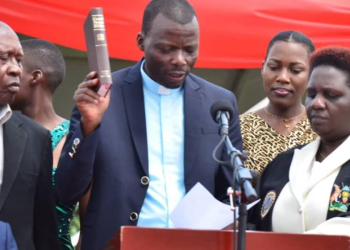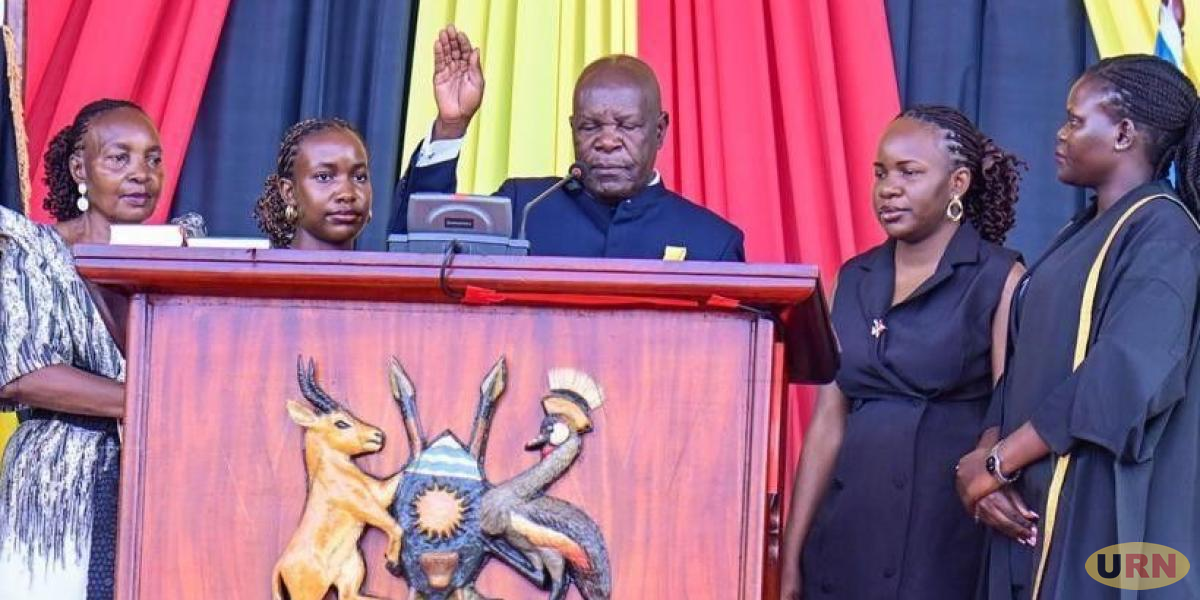
Ofwono Opondo P’Odel, the newly elected Representative for Older Persons, stepped forward without a holy book and took the oath with only his right hand raised. Unlike most MPs, he did not invoke God during the ceremony and omitted the phrases, “I swear in the name of the Almighty God” and “So help me God.”
Videos and images of the moment circulated widely online, triggering conversations on religion, public office, and personal conviction in Uganda’s political space. Some Ugandans praised the former government spokesperson for what they described as an honest and principled approach to leadership. Others questioned whether the move reflected his personal views on religion and faith.
“Ofwono Opondo’s swearing-in is the best. We are all sinners. It is not good to swear on the Bible when we know we are not perfect,” One user posted on X, while others interpreted the gesture as a subtle statement on secular governance in a country where religion remains deeply woven into politics and public life.

Speaking to Uganda Radio Network, parliamentary governance and legal reform expert Timothy Msobor Chemonges, the Executive Director of the Centre for Policy Analysis (CEPA), said the real issue in modern democratic governance is not whether a public official swears using a Bible, Quran, or a secular affirmation, but whether they remain committed to constitutional duty, personal conscience, and accountability to citizens.
“A constitutional democracy does not require visible religiosity. What it requires is fidelity to the Constitution and the rule of law,” Chemonges said. “That is why many constitutions, including Uganda’s, recognise both a religious oath and a solemn affirmation. The law accepts that public service can be grounded either in religious conviction or in personal conscience.”
He noted that while oath-taking carries deep cultural and moral symbolism by projecting seriousness, humility, and a sense of duty, such symbols alone are not a guarantee of integrity in leadership.
“History has shown that some leaders have sworn on holy books and still betrayed public trust, while others who simply made affirmations have served with honour and ethical discipline,” he said, adding that legally, Ofwono Opondo appeared to have acted within his constitutional rights, noting that both the Constitution and the Oaths Act place greater emphasis on the substance of the commitment to uphold the Constitution and serve faithfully, rather than on religious ritual or ceremonial symbols.
“Where an oath has been duly administered and taken, the fact that the person to whom it was administered had, at the time of taking the oath, no religious belief, shall not for any purpose affect the validity of the oath,” the law states.
Although Ofwono has not publicly explained his decision, he has previously said he does not identify as religious and has only visited churches such as Lubaga Cathedral for tours rather than worship. Legal experts say his choice was fully within the law and consistent with the constitutional options available for public office holders.
Outgoing Mawokota South MP and lawyer Yusuf Nsibambi said Uganda’s Constitution clearly provides for both religious oaths and secular affirmations during swearing-in ceremonies. According to Nsibambi, Article 81 of the Constitution and the Fourth Schedule give leaders the option of either taking a religious oath invoking the Almighty God or making a secular affirmation without reference to God or the use of a holy book.
He added that the Oaths Act protects individuals who object to taking a religious oath and that they should not be compelled to explain their reasons for choosing the secular option. Despite the legal provisions, secular affirmations remained rare during the swearing-in ceremony, with the overwhelming majority of MPs opting for religious oaths, a reflection of Uganda’s strong Christian and Muslim traditions.
Ofwono’s decision has now revived wider debate about the place of religion in leadership and whether Uganda’s political environment is sufficiently open to non-religious or openly agnostic public officials.
Nsibambi also raised concern over the alterations some leaders make to the prescribed wording of the oath. He cited instances where some Muslim leaders conclude with the phrase “So help me Allah” instead of the constitutionally prescribed wording. “I don’t think it is legally right. The Constitution is clear, and one should not substitute prescribed words,” he said.
His remarks revive memories of a similar controversy during the swearing-in of the 11th Parliament in 2021, when John Musila, then MP-elect for Bubulo East, was directed to retake his oath after replacing “Almighty God” with the Rastafarian phrase “Almighty Jah.”-URN. Give us feedback on this story through our email: kamwokyatimes@gmail.com