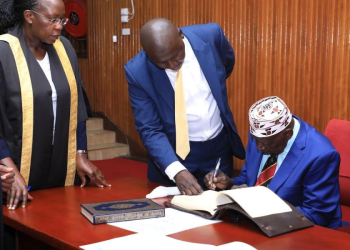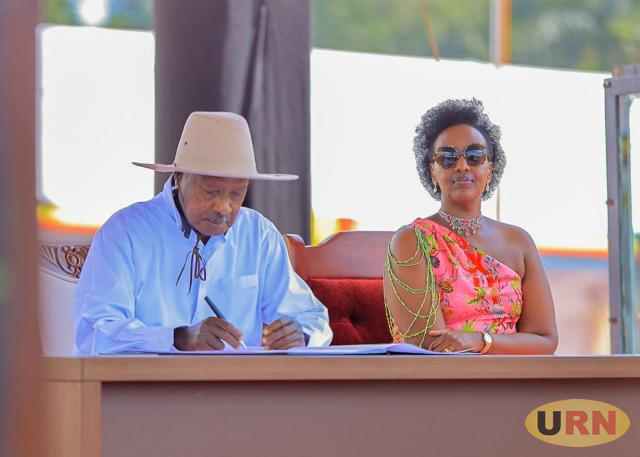
President Yoweri Museveni entered his seventh term in office promising to fight corruption just like he had promised in the previous years. Speaking after taking the oath and after receiving the instruments of power, Museveni this time around urged asked his voters to police the thieves themselves.
Museveni warned against the the diversion of development funds, such as those under the Parish Development Model (PDM).
“If anyone is diverting the money, you are empowered to deal with him or her through the Local Council system,” Museveni declared, urging Ugandans to utilize democratic structures to protect public resources.

His call has however, drawn criticism from a section of the public, especially the opposition politicians who have accused him of lacking the political will to fight graft or selectively bringing some of the perpetrators to book. They urge the President to move beyond the political rhetoric.
The outgoing Kira Municipality MP Ibrahim Ssemujju Nganda in disagreed that fight against corruption should be shifted to grassroots enforcement. He was responding to the President’s speech delivered at Kololo on Tuesday. “I don’t think he remembers what he said,” Ssemujju said.
“Corruption is not just theft of money. It includes electoral malpractice, nepotism, and the concentration of power within close family networks.”
The President urged citizens to take a more active role in fighting corruption by using Local Council structures to confront officials accused of diverting public funds. “If anyone is diverting the money, you are empowered to deal with him or her through the Local Council system,” Museveni said, specifically pointing to programmes such as the Parish Development Model (PDM).
The exchange highlights a familiar tension in Uganda’s anti-corruption debate: whether accountability should be driven from the top through institutions, or pushed outward to citizens at the local level. Museveni’s latest remarks come five years after his 2021 inauguration pledge to wage what he called a “relentless war” on corruption and organised theft of public resources.
At the time, his government leaned heavily on digital reforms and decentralised development financing. Those reforms included e-government systems designed to reduce human interaction in public service delivery, and the Parish Development Model intended to channel funds directly to local communities.
Yet as he begins another term, the results remain mixed. Government digitisation efforts, including Electronic Government Procurement (e-GP) and automated tax systems, have reduced petty bribery in services such as passport processing and driving licence applications.
A recent analysis by PricewaterhouseCoopers (PwC) notes that digitisation often shifts corruption into more complex, less visible digital systems rather than eliminating it entirely.
Similarly, reports from the Inspectorate of Government and international bodies such as the OECD warn that syndicate-driven fraud has increasingly migrated into backend procurement and financial systems.
In March 2026, Inspector General of Government Lady Justice Naluzze Aisha Batala said enforcement had intensified through lifestyle audits and the Leadership Code Tribunal, adding that recent disciplinary actions in the judiciary and police signalled a tougher stance.
But critics argue that enforcement remains selective. Leader of the Opposition Joel Ssenyonyi pointed to the 2024/2025 Parliamentary Service Awards controversy as evidence that corruption has not been eliminated but elevated.
“The system is still rewarding the very people it claims to fight,” Ssenyonyi said. Auditor General Edward Akol has also raised concerns about persistent leakages in local government spending, despite improvements in central government procurement systems.
A new joint initiative involving the PPDA, Auditor General’s Office, and Inspectorate of Government is now targeting beneficial ownership structures used to conceal fraud through shell companies.
High-profile scandals over the past five years continue to shape public perception. These include the Karamoja iron sheets scandal, in which over 14,500 iron sheets meant for vulnerable communities were diverted by senior officials. Although several individuals were implicated, only State Minister Agnes Nandutu has so far been convicted and sentenced.
Other cases include the 1.7 billion shillings Parliamentary Service Award scandal, the ongoing investigations into missing funds at the Ministry of Education, and allegations of infrastructure fraud in western Uganda.
The aviation sector has also faced scrutiny, with Uganda Airlines reporting heavy losses during the tenure of former CEO Jenifer Bamuturaki, before her removal.
However, the Inspectorate of Government continues to investigate cases of ghost beneficiaries and extortion by local officials, with reports of illegal fees imposed at the parish level.
Transparency International’s latest assessment places Uganda’s corruption perception score between 25 and 27 out of 100, reflecting persistent governance challenges despite reform efforts. The Inspectorate’s 2025–2030 strategy now prioritises asset recovery and wealth tracing, signaling a shift from simply removing corrupt officials to targeting illicit enrichment itself.
As Museveni begins another term, the debate remains unresolved. His administration has reshaped how public services operate through digital systems and decentralised funding, but critics argue that corruption has simply evolved rather than declined. The question now is whether citizen-led enforcement, as the President proposes, can succeed where institutional and technological reforms have struggled — or whether the fight against corruption still requires a stronger top-down reckoning-URN. Give us feedback on this story through our email: kamwokyatimes@gmail.com