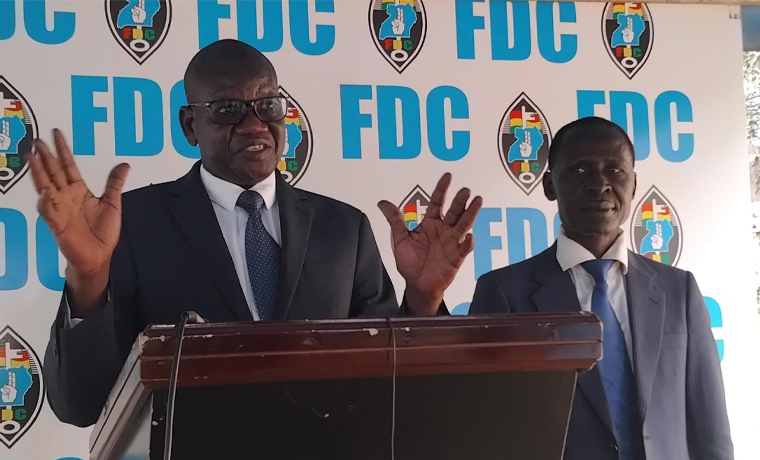
Forum for Democratic Change (FDC) President Patrick Amuriat Oboi says the 2026 International Labor Day celebrations were what he described as a “detached ritual.” He said the occasion was instead used to award medals while ignoring the “poverty wages” of the Ugandan worker.
The national Labor Day celebrations were held last Friday in Buikwe district, presided over by Prresident Muveni as the Chief guest. Amuriat criticized the government for overseeing “a stagnant wage regime.” He observed that the wage regime has not been adjusted in over four decades.
He noted that the current legal threshold remains “shy” of economic reality, effectively tethered to the 6,000 Shillings per month rate set in 1984.

“Labor Day must not be a day where government officials celebrate while workers who wake up at 5 a.m. to walk to a factory for a wage that cannot pay rent are expected to cheer,” Amuriat stated.
The former presidential candidate further warned of an increasing “deal economy,” a shadow sector where graduates rely on opportunistic brokerage and informal commissions because the formal economy has no space for their skills.
While making her presentation during the International Labour Day celebrations on Friday, Betty Amongi, the Minister of Gender, Labour, and Social Development, said that the government was on track in addressing the wage crisis in the country. She noted that rather than a blanket national figure, the government is moving toward a sectoral minimum wage model.
Amongi revealed that the Minimum Wage Advisory Board and Wages Councils have been established to determine pay scales specific to industries such as ICT, manufacturing, and services.
“A cabinet paper for the Minimum Wage Advisory Board composition has been written to the Cabinet Secretariat,” Amongi explained. “This will allow the Cabinet to approve the board so it can receive and implement reports from the councils already working.”
The Minister also highlighted the recent assent to a new Labour Act, which she claims provides the legal teeth to enforce contracts between employers and employees, particularly for casual and domestic workers.
President Yoweri Museveni, while officiating over the celebrations, rotated the debate away from wage figures, focusing instead on the “employability” of Ugandan graduates. He attributed the lack of formal jobs to a mismatch between university education and market needs.
The President told the congregation in Buikwe how he encountered a graduate of psychology and asked where he was going to get a job.
“I asked somebody who had a BSc in psychology, ‘What will you do with that?’ He said, ‘I can look at you and know what you are thinking.’ I said, ‘How many jobs are there for that?’ He said he could work in prisons. I asked how many prison jobs there are in Uganda? He didn’t respond.”
The President urged youth to “retool” by seeking diplomas in practical fields like catering and procurement. He defended his administration’s focus on infrastructure, specifically electricity and the new rail line, as the only sustainable way to attract the 5,000 factories needed to drive up employment.
The minimum wage issue has been a recurring point of friction in Parliament for years. While the Minimum Wages Bill was legislated and passed by Parliament, President Museveni declined to sign it into law in 2019, arguing that it would discourage investors and that the existing 1957 Minimum Wages Advisory Boards Act was sufficient.
The FDC has explicitly rejected this stance. “We reject the idea that Ugandan workers must remain poor so that Uganda remains attractive to investors,” Amuriat added, arguing that better wages drive the domestic demand necessary for genuine economic growth.
As the Cabinet prepares to discuss the new Advisory Board’s composition, the Ugandan worker remains in a state of limbo- caught between the government’s promise of infrastructure-led growth and the opposition’s demand for a “living wage” that reflects the 21st century-URN. Give us feedback on this story through our email: kamwokyatimes@gmail.com.